
Case Study
Reviewing sheep creek: can montana really deliver non-chinese gallium?: Latest Developments and


Context and Critical Findings on Sheep Creek
The Sheep Creek project in Ravalli County, southwest Montana, has moved rapidly from a little-known rare earths prospect to one of the most cited US candidates for non-Chinese gallium supply. Operated by US Critical Materials Corp. (USCM), the project combines unusually high gallium grades with high rare earth element (REE) grades in a carbonatite system on US Forest Service land. Earlier coverage framed the story under the headline “reviewing sheep creek: can montana really deliver non-chinese gallium?” This assessment revisits that question from an operational continuity and supply chain risk perspective, rather than a resource-promotion standpoint.
Over multiple quarters of monitoring technical disclosures, lab verifications, and regional stakeholder reactions, several critical findings have emerged. First, independent assays from Activation Laboratories and Idaho National Laboratory (INL) confirm gallium values that are well above the levels typically associated with economic byproduct recovery, alongside rare earth grades that position the system among the highest-grade carbonatite-hosted deposits reported in North America. Second, the project remains at a very early stage: surface sampling and mapping dominate the dataset, with no public indication of a compliant resource estimate or sustained drilling program. Third, the land status-within the Bitterroot National Forest-introduces a complex permitting pathway and visible local opposition, which directly affects timeline and continuity risk.
In parallel, China’s dominance of refined gallium supply and recent export restrictions create a strategic backdrop in which even early-stage US projects attract disproportionate attention. From an operational continuity perspective, however, high grades alone do not equate to a near-term, reliable alternative supply source. The gap between surface assays and a producing, resilient gallium-REE operation involves technical flowsheet development, federal permitting, infrastructure build-out, and long-term ESG performance in a sensitive watershed. Each of these steps introduces potential disruption points that are at least as material as the geology itself.
Project Background and Geological Profile
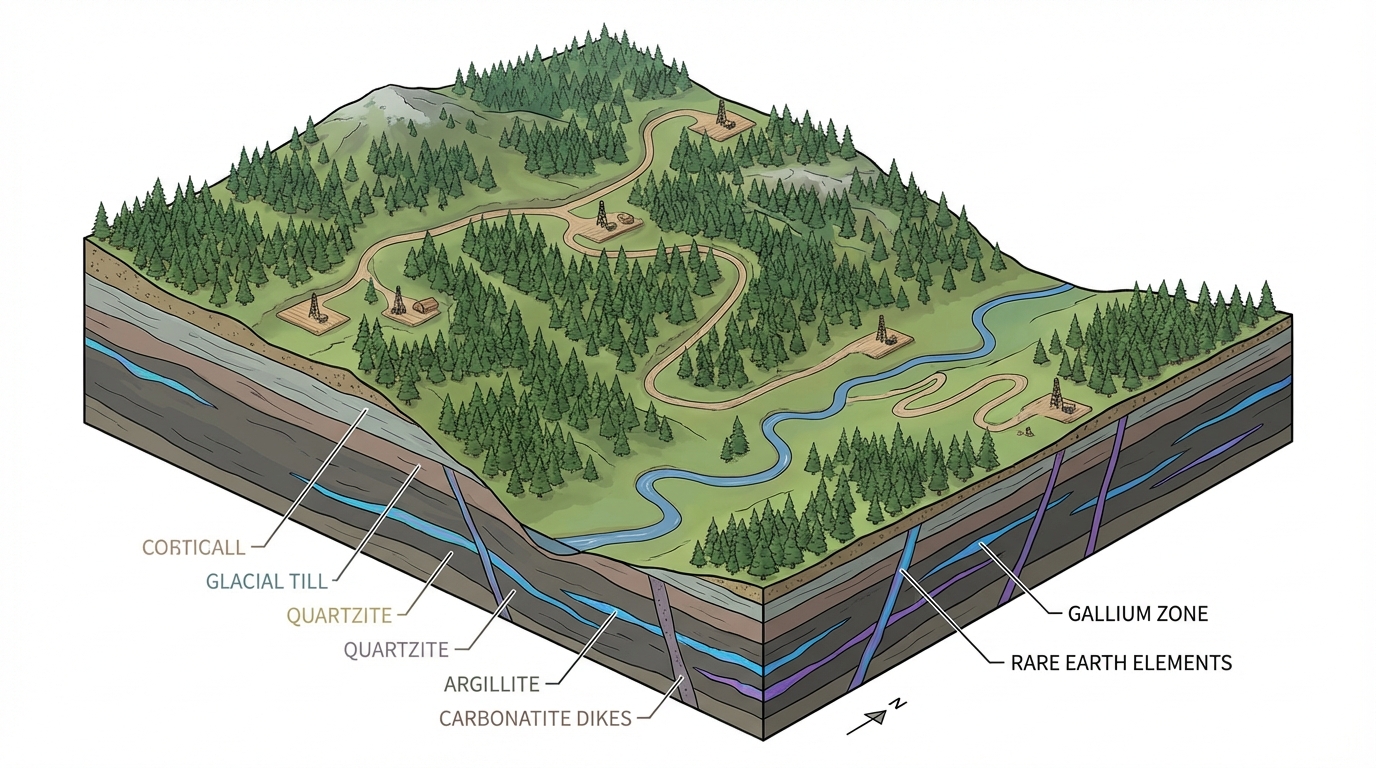
Sheep Creek spans more than 200 lode claims in the Bitterroot National Forest, covering several thousand acres in Ravalli County. Since around 2021, USCM geologists have mapped and sampled over 60 carbonatite dikes, locally up to roughly 3 meters wide and traceable for hundreds of meters along strike. These dikes host a package of light rare earths (including neodymium and praseodymium), with additional critical elements such as niobium, scandium, strontium, and barium. Gallium enrichment appears closely associated with the REE-bearing carbonatites.
Reported assays present a striking picture. Company releases and subsequent commentary cite surface samples with:
- Average gallium values around 90 ppm across dozens of analyses, with higher-grade zones in the 180-385 ppm range and individual samples reported up to 1,370 ppm.
- Total rare earth element (TREE) grades up to 20.1% in standout samples, with broader averages near 9% TREE in key zones.
- Neodymium-praseodymium (NdPr) contents reported around 2.4% in the highest-grade material.
These numbers, as cited in public communications and technical summaries, significantly exceed the roughly 50 ppm gallium levels commonly referenced for profitable byproduct recovery from bauxite or zinc circuits. Importantly for permitting and processing, several sources emphasize comparatively low thorium content in the Sheep Creek mineralization, which differentiates it from monazite- or thorium-rich REE deposits where radiological compliance and waste handling can become dominant operational challenges.
From an operational risk standpoint, the geological setting carries both strengths and uncertainties. Carbonatite-hosted REE deposits such as Mountain Pass in California have an established processing precedent, suggesting that the broad class of mineralization is not exotic from a metallurgical perspective. However, Sheep Creek’s current dataset is heavily weighted toward surface grab and channel samples. Without a grid of drill holes, down-dip continuity, grade distribution, and tonnage remain conceptual. That is a central risk inflection point: continuity of grade at depth and across thicker mineable widths will determine whether the reported surface numbers translate into a sustainable orebody or remain localized high-grade showings.
Grade Verification and Processing Implications
A key strength of the Sheep Creek story to date is independent grade verification. Activation Laboratories (Actlabs) and Idaho National Laboratory have both been cited as confirming high TREE and gallium values in representative samples. Under a Cooperative Research and Development Agreement (CRADA), INL has applied advanced analytical techniques to check both REE and gallium content as well as potential deleterious elements. Reported analyses from this work include gallium values in the 250-350 ppm range for selected samples and REE grades in line with company claims.
For operational continuity, verified grades affect several elements of the risk profile:
- Processing route options. High REE and gallium grades in carbonatite suggest that flotation followed by acid leaching and solvent extraction could be viable, drawing on flowsheet analogues from other REE operations. Low thorium content, if confirmed across the deposit, simplifies waste classification and tailings design.
- Co-product strategy. The co-occurrence of REEs and gallium allows a multi-product plant concept where REE concentrates and gallium streams are recovered from the same ore. This can support operational resilience by diversifying revenue streams, though it also requires more complex separation infrastructure.
- Mass balance and scale. High gallium grades potentially allow meaningful production from relatively modest ore tonnages compared with lower-grade byproduct sources. That, in turn, can reduce mining footprint, haulage intensity, and exposure to some environmental impacts-if those grades prove laterally and vertically consistent.
USCM has publicly aligned with GreenMet in Utah and is collaborating with INL to design and test a gallium extraction process. Early statements characterize an “environmentally sound” flowsheet concept, with Phase I CRADA efforts focused on verification and Phase II aimed at separation and recovery optimisation. From a risk perspective, Sheep Creek’s gallium story is therefore tightly coupled to the success of a yet-to-be-proven processing flowsheet. Any delays, technical setbacks, or reagent supply issues affecting that flowsheet would directly impact the ability to translate grades into reliable output.
Project Stage and Execution Capacity
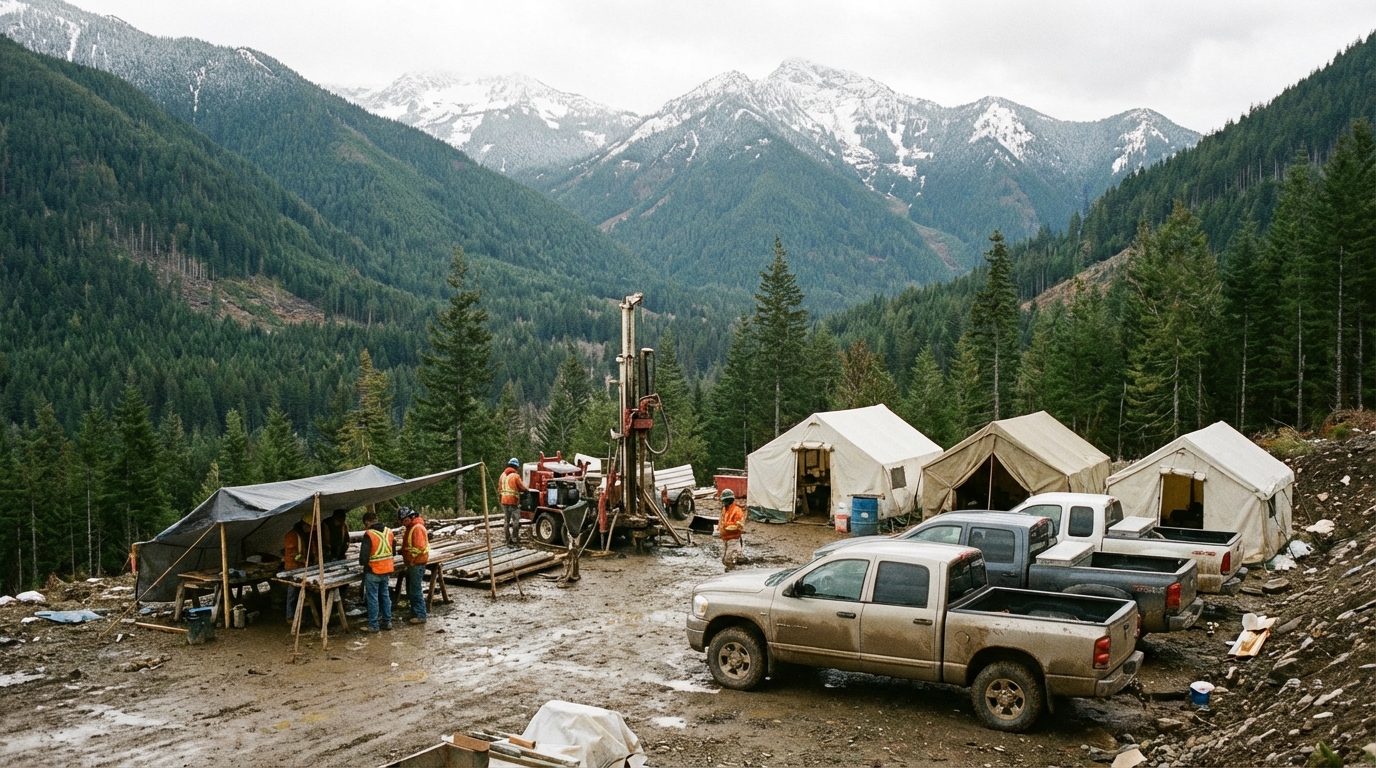
Despite the strong assay narrative, Sheep Creek remains an exploration-stage project without a defined resource under frameworks such as NI 43-101 or JORC. To date, public information points to mapping, surface sampling, and limited trenching, with no large-scale drilling program disclosed. There is also no published pre-feasibility or feasibility study, and no formally announced production timeline.
From an operational continuity lens, that early stage amplifies several uncertainties:
- Resource definition risk. Surface-focused datasets inherently risk grade overestimation due to exposure bias. A drilling campaign capable of delivering tens to hundreds of holes would be needed to constrain tonnage, variability, and geotechnical parameters relevant for mine design.
- Organizational and financing capacity. USCM is described as a privately held, Utah-based critical minerals company. Transitioning from exploration to construction-grade project execution requires a different organizational footprint, including engineering, environmental, and operational teams, as well as access to substantial capital. Public materials reference potential support under US Department of Defense (DoD) and Department of Energy (DOE) critical minerals programs, but no definitive large-scale funding packages have been announced.
- Partner and offtake structure. The alliance with GreenMet and the CRADA with INL are positive signals for technical alignment, yet the long-term operating model—integrated mine-to-metal vs. mine-focused with toll processing—remains open. That structural choice will influence both operational control and exposure to external processing bottlenecks.
In comparison with more advanced REE projects on private or state land, Sheep Creek therefore sits at the earlier, higher-uncertainty end of the development spectrum. The upside is substantial technical promise; the trade-off is greater schedule and execution risk.
Logistics, Infrastructure, and Continuity Constraints
Operational continuity is often constrained less by ore grades than by logistics. Sheep Creek is located in a relatively remote portion of Ravalli County, accessed via forest roads within the Bitterroot range. At the exploration stage, this remoteness is manageable with light vehicles and small equipment. For a full-scale operation, however, the following logistics elements become central:
- Road access and seasonal reliability. Haulage of ore, concentrates, or reagents through mountainous terrain is sensitive to winter conditions, landslides, and forest fire closures. Road upgrades, snow management, and risk mitigation for extreme weather are likely prerequisites for year-round operations.
- Power supply. No dedicated high-capacity power infrastructure currently serves a mine at Sheep Creek. A processing plant, particularly one involving grinding, flotation, and hydrometallurgy, would require significant electrical power. That implies either grid extensions, potential substation investments, or some combination of diesel and renewable generation—all subject to permitting and reliability considerations.
- Transport to processing hubs. Public indications suggest that early-stage processing trials could involve links to facilities in Idaho (INL) and Utah (GreenMet). In an operating scenario, bulk shipment of concentrate or partially processed intermediates would depend on road and possibly rail connections out of western Montana to more industrialized hubs. Any disruption along these corridors—strikes, accidents, or infrastructure damage—would have immediate implications for continuity of supply.
These infrastructure factors are manageable but non-trivial. In contrast to coastal or rail-adjacent operations, Sheep Creek’s inland, forested setting adds a layer of logistical complexity that has to be resolved before any long-term supply commitments become credible.

Regulatory, Environmental, and Social License Risks
The land tenure context at Sheep Creek may be the single largest driver of schedule risk. The claims lie within the Bitterroot National Forest under US Forest Service (USFS) jurisdiction. Even for exploration, this has already drawn attention from local communities and environmental groups, with particular concern around potential impacts on water quality, fisheries, wildlife, and recreation in the West Fork drainage.
Several structural elements shape the regulatory path:
- NEPA review. Any move from small-scale exploration to full mining operations on USFS land typically triggers an Environmental Impact Statement (EIS) under the National Environmental Policy Act (NEPA). Historical experience on other USFS mining projects suggests multi-year timelines, with numerous opportunities for legal challenge and administrative delay.
- Montana state requirements. State-level mine operating permits, water discharge permits, and reclamation bonding would apply in parallel. Montana policy has become more favorable to critical minerals in recent years, but water-related concerns remain politically sensitive, particularly in headwater regions.
- Radioactivity considerations. Low thorium levels, if confirmed at scale, simplify one aspect of permitting by reducing radiological oversight requirements. That reduces the risk of the project being categorized alongside monazite-heavy operations, which often face a higher level of scrutiny.
- Community acceptance. Media reports from 2024 and early 2025 indicate a community that is at least split on the desirability of a mine in this location. Continued opposition could manifest in appeals, litigation, or demands for more stringent conditions, any of which can impact continuity once operations are underway.
From a supply chain standpoint, these factors translate into extended lead times before any material reaches downstream users and an elevated risk of interruptions from permit reviews or legal challenges throughout the life of the project.
Role in Non-Chinese Gallium Supply Chains
Sheep Creek’s prominence arises largely from the global gallium context. Public data and industry commentary cited in the earlier article indicate that China currently accounts for the overwhelming majority of refined gallium supply—often framed at around 98%—with production primarily as a byproduct of bauxite and zinc processing. In 2023 and 2024, Chinese authorities introduced export licensing regimes and quotas on gallium, leading to significantly reduced export volumes and notable price increases. Reports referenced in the prior analysis cited spot price moves from roughly $250/kg to around $650/kg over this period.
Gallium’s importance lies in its role in gallium arsenide (GaAs) and gallium nitride (GaN) semiconductors, which underpin radar systems, 5G and advanced wireless infrastructure, LEDs, and high-efficiency power electronics often linked to data centers and electric mobility. The United States consumes a meaningful share of global gallium output—estimates in the earlier coverage indicated around 50 metric tons annually—yet has relied almost entirely on imports. Against that backdrop, a domestic deposit with reported gallium grades significantly above byproduct norms takes on outsized strategic significance.
The earlier article positioned Sheep Creek as potentially capable of supplying a non-trivial portion of US gallium requirements, citing conceptual scenarios of 10–50 metric tons per year at scale. Those figures are indicative rather than bankable at this stage; no public mine plan, processing plant design, or reserve statement supports a definitive capacity figure. The key structural takeaway, however, is clear: if drilling and permitting ultimately support a commercial operation, Sheep Creek’s grade profile would allow domestic gallium production at a scale that materially reduces exposure to single-country supply risk.
Key Operational Highlights and Risks
Summarizing the project from an operational continuity and supply chain perspective highlights a set of intertwined strengths and vulnerabilities:
- Highlight – Exceptional grades with third-party verification. Gallium and REE grades reported at Sheep Creek, and verified by external laboratories, sit well above many peer projects, offering a potential foundation for a compact but high-impact operation.
- Highlight – Alignment with US strategic materials policy. Gallium and REEs are explicitly listed as critical materials by US agencies, and the project has already attracted federal technical collaboration through the INL CRADA framework.
- Risk – Early-stage resource definition. Lack of a compliant resource estimate and limited subsurface data keep fundamental uncertainties high regarding tonnage, continuity, and mine design.
- Risk – Complex federal land permitting. Location within a national forest and emerging local opposition create a multi-layered regulatory environment, with NEPA-driven schedules and potential litigation risk.
- Risk – Dependence on a new processing flowsheet. Gallium recovery at scale hinges on successful development and industrialization of an integrated REE–gallium process, currently under laboratory and pilot-scale evaluation.
Risk Inflection Points and Signals to Monitor
After synthesizing the latest disclosures and stakeholder reactions, several milestones stand out as structural “risk inflection points” for Sheep Creek’s ability to become a reliable non-Chinese gallium source:
- Completion of a substantial drilling campaign. Announcement and execution of a multi-phase drill program, followed by a first-pass resource estimate, would significantly narrow uncertainty around volume, grade distribution, and mineability.
- Demonstration of a pilot-scale flowsheet. Results from INL and GreenMet work that move beyond bench tests to continuous or semi-continuous pilot runs, with documented gallium recoveries and impurity management, will be critical in gauging technical viability.
- Regulatory milestones on USFS and state permits. Publication of a Notice of Intent, scoping decisions, draft EIS documents, or major state-level permit applications will signal the trajectory of the permitting timeline and the emerging shape of conditions attached to any approval.
- Community engagement outcomes. Structured agreements or frameworks with local communities and stakeholders, or conversely, escalating opposition and legal action, will strongly influence continuity risk once construction or operations begin.
- Clarification of downstream integration. Clearer articulation of where and how gallium will be refined—whether in-house, through dedicated domestic facilities, or via third-party partnerships—will shape exposure to external processing bottlenecks.
Monitoring these signals over time will help define whether Sheep Creek’s trajectory is converging on a robust, multi-decade supply source or remaining constrained by permitting, technical, or social hurdles.
Operational Continuity Outlook
In its current state, Sheep Creek represents a high-potential but high-uncertainty node in the emerging non-Chinese gallium supply chain. The combination of exceptionally high reported gallium and REE grades, low thorium content, and alignment with US strategic materials policy gives the project a profile that stands out among domestic peers. Independently verified assays and federal laboratory engagement suggest that the geological and metallurgical story has real substance rather than being purely promotional.
At the same time, the early development stage, reliance on surface sampling, complex permitting environment on US Forest Service land, and dependence on new processing infrastructure all represent substantial hurdles to near- or medium-term operational continuity. Even under supportive policy regimes, comparable projects in similar regulatory contexts have often required many years to progress from promising exploration results to stable production.
In practical terms, Sheep Creek is unlikely to alter gallium supply dynamics in the immediate future. Over a longer horizon, if forthcoming drilling, flowsheet development, and permitting milestones are achieved, the project has the potential to supply a material fraction of US gallium demand as part of an integrated REE–gallium operation. The strategic value in that scenario would not lie solely in the volumes produced but also in the diversification away from a heavily concentrated, China-centric supply base.
For stakeholders focused on secure access to gallium and high-value rare earth oxides, Sheep Creek therefore warrants close, technically grounded tracking. The emphasis, from an operational continuity perspective, is less on headline grade figures and more on the unfolding evidence around resource definition, process reliability, permitting resilience, and the durability of community and regulatory support in one of Montana’s more environmentally sensitive regions.


