
Sentiment Analysis
Critical Minerals in 2026: Where Processing Constrains Supply


Refining concentration is the dominant critical-mineral supply risk in the International Energy Agency’s Global Critical Minerals Outlook 2026. Industrial exposure depends on access to qualified magnets, anodes and high-purity materials — not simply on the location or availability of mined ore.
Across the refined critical minerals assessed by the IEA, the average market share of the leading supplier for each mineral reached 70% in 2025, up from 68% in 2020. This measures concentration across markets, rather than one country’s share of all refined production. China and Indonesia generated more than three-quarters of global supply growth between 2023 and 2025, according to the report’s market overview. Additional production has therefore not necessarily created more independent supply routes: much of it has reinforced the jurisdictions already dominating processing.
For industrial buyers, the critical distinction is between mineral availability and usable material. Ore must pass through refining, chemical conversion and component manufacturing before reaching a production line. A geographically diversified mining portfolio can still depend on one country for separation, battery-grade chemicals or permanent magnets. The IEA’s highest-vulnerability group includes gallium, magnet rare earths, yttrium, graphite, tungsten, tellurium, cobalt and germanium, reflecting concentration, limited substitution and industrial importance rather than tonnage alone.
Rare-earth magnets: separation and fabrication constrain supply
Rare earths show both the progress and limits of diversification. The IEA reports that China’s refining share declined from more than 90% in 2023 to 85% in 2025, supported by new US projects and higher Malaysian production. Its projected decline to 70% by 2035 depends on planned projects entering service on schedule, rather than representing capacity already available to manufacturers.
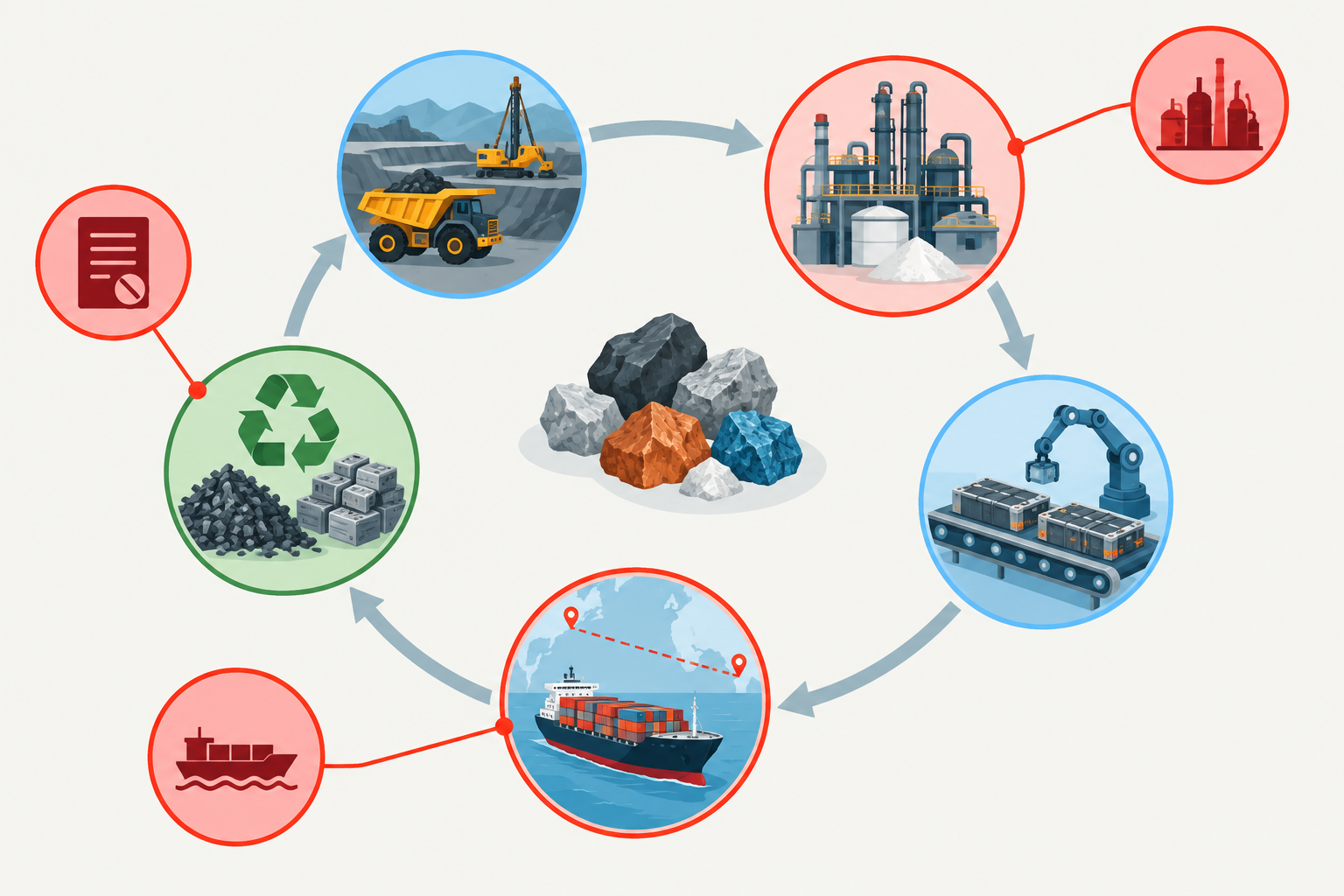
The manufacturing chain explains the remaining exposure. Mixed rare-earth feedstock must be separated into individual elements, converted into metals and alloys, and manufactured into magnets with the required magnetic, thermal and mechanical properties. Automotive traction motors, wind-turbine generators, robotics and aerospace actuators need approved components, not interchangeable tonnes of rare-earth concentrate. Heavy rare-earth separation, alloy production, magnet fabrication and coatings can each become a bottleneck.
China’s April 4, 2025 controls covered seven heavy rare-earth elements and related compounds, metals and magnets, introducing export-licensing requirements. The IEA’s 2026 outlook documents the downstream impact: shortages of permanent magnets forced some automakers to reduce utilisation or temporarily halt operations. These were manufacturing disruptions in 2025, illustrating how licensing restrictions can interrupt delivery even when material exists within the supply chain.
The October 2025 expansion extended exposure to foreign-made products containing Chinese-sourced rare earths or produced using Chinese technologies, and covered processing equipment and technologies. The IEA’s 2026 outlook records a one-year suspension of the expanded measures until November 2026. Separately, the IEA estimated that full implementation could expose USD 6.5 trillion of annual downstream production outside China. That figure is a conditional estimate of production at risk across industries, not realised economic losses.

Graphite: mine diversification leaves the anode bottleneck intact
China accounts for more than 90% of global refined graphite supply in the IEA outlook. The relevant battery input is not simply natural flake graphite or synthetic graphite: it is processed anode material. Natural graphite requires purification and shaping, while synthetic graphite follows a manufactured-carbon route; both must meet the specifications of the intended anode product, including surface treatment where required.
Cell manufacturers qualify particle size, purity, electrochemical performance and cycle life. A replacement source can therefore be chemically similar without being immediately interchangeable on an existing production line. For electric vehicles, consumer electronics and stationary storage, the decisive sourcing questions concern the location of conversion and coating, the availability of qualified grades, and the capacity to produce them consistently. Adding a non-Chinese graphite mine does not resolve dependence if its output still requires Chinese anode processing.
Battery metals: growth can deepen geographic dependence
Nickel and manganese demonstrate why expanding supply and improving resilience are different outcomes. Indonesia dominated recent nickel supply growth, while almost all manganese supply growth between 2023 and 2025 originated from the leading supplier, according to the IEA. China is the top manganese refiner. Battery manufacturers consequently face exposure at chemical conversion as well as extraction.
For nickel, integrated Indonesian processing includes high-pressure acid leach, which uses acid under elevated pressure to extract nickel from laterite ores. Battery-chain exposure therefore includes processing infrastructure and operating conditions, not only mine output. Manganese requires particular attention at battery-grade conversion, while cobalt sourcing must distinguish the mine jurisdiction from the refinery producing cathode chemicals. Stainless steel, superalloy and battery buyers also require different product forms; aggregate metal supply does not establish availability of each grade.
Changing battery chemistry can reduce cobalt intensity, but it introduces another manufacturing decision rather than an instant sourcing substitute. Performance requirements, cell qualification and production-scale capability constrain how quickly a chemistry change can reduce exposure.
Semiconductors, tooling and solar face smaller-volume constraints
Gallium and germanium sit in the IEA’s high-vulnerability group because concentrated supply intersects with limited substitution and strategic applications. China supplies more than 90% of refined gallium. For compound semiconductors, power electronics, fibre optics and infrared systems, the relevant bottlenecks include high-purity conversion, substrate production and approved fabrication routes. Securing a feedstock contract does not by itself establish access to a qualified semiconductor input.
Processing technology is a separate dependency. The IEA’s policy analysis identifies restrictions on technology and equipment as an additional constraint on diversification. An alternative producer needs more than raw material and a plant location: it also needs the equipment, process capability and technical inputs required to reproduce the specified product.
Tungsten creates a similar problem for cutting tools, hard metals, aerospace and defence, where substitution can alter wear resistance or high-temperature performance. Scrap collection alone is insufficient; recovered material must pass through suitable processing and refining before returning to manufacturing. Tellurium presents a different constraint for thin-film photovoltaics and specialised electronics: its supply depends partly on recovery as a by-product of other metals. Higher tellurium demand cannot independently trigger an equivalent increase in host-metal mining.
What reduces exposure: qualified processing, recovery and visibility
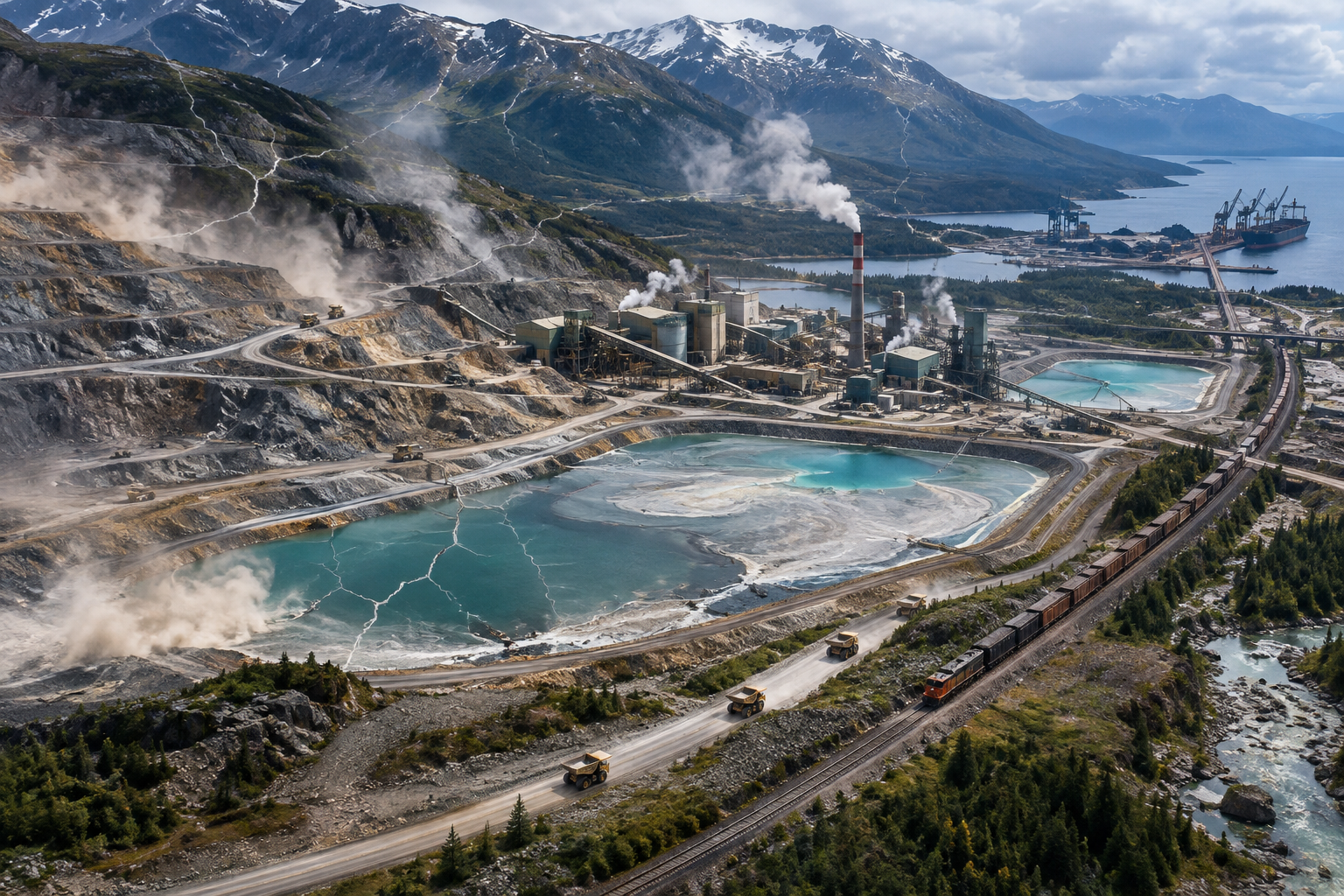
New mines address the upstream stage. Refineries, separation plants, anode facilities, magnet factories and recycling plants address different downstream constraints. Their contribution becomes operational only after construction, commissioning, product qualification and consistent commercial delivery. Nameplate capacity describes a plant’s intended output; it does not establish how much approved material customers can obtain during ramp-up.
The EU Critical Raw Materials Act reflects this broader approach. It covers 34 critical raw materials, including 17 strategic raw materials, and sets 2030 benchmarks of 10% EU extraction, 40% processing and 25% recycling of annual EU consumption for strategic raw materials, as described by the European Parliamentary Research Service. These are policy benchmarks, not measurements of current production. Their industrial significance lies in treating processing and recovery as distinct capabilities that require their own investment.
EU-funded researchers are also developing early-warning capabilities using supply-chain mapping, AI analysis of public reports and satellite imagery, including for synthetic graphite and rare earths. Such tools can help identify geographic dependencies and emerging disruptions. They cannot establish that an alternative supplier’s output meets a customer’s specification or create conversion capacity where none exists.
Processing economics can also limit diversification. In its 2026 outlook, the IEA estimates that new refining projects outside dominant suppliers face capital costs 20% to more than 150% higher and operating costs averaging about 50% higher. It identifies feedstock and energy prices, technical and skills constraints, infrastructure gaps and lengthy permitting as disadvantages. These comparisons do not imply the same premium for every project. The report also finds that surging acid prices pushed acid above energy as the largest cost component in some processing cases, showing how reagent supply can constrain otherwise diversified production.
The most useful measure of diversification is therefore deliverable, qualified output at the constrained stage. For a vehicle manufacturer that may mean approved magnets; for a battery producer, coated anode material or cathode chemicals; for an electronics supplier, high-purity semiconductor inputs. Counting additional mines without tracing those conversion steps can overstate how much disruption a supply chain can absorb.


