
Industry Trends
U.S. Recycling Export Controls: Our Feedstock Risk Assessment


Effective August 27, 2026, U.S. controls require BIS authorization for covered black mass exports, alongside domestic-sales allocation and physical-retention requirements. European refiners face a feedstock-access constraint that remains separate from EU waste-shipment compliance.
The U.S. measure covers qualifying lithium-ion battery black mass and tungsten waste and scrap. End-of-life permanent-magnet scrap is outside the named scope of this BIS rule; that boundary does not determine the export treatment of every magnet-scrap form under other controls.
A sale to a U.S. buyer and retention at a U.S. processing site are separate conditions. Under the Bureau of Industry and Security’s black mass rule, selling to a U.S. person does not, by itself, authorize the material to leave the country. That distinction changes how recyclers and European refiners assess an otherwise usable batch: chemical suitability, ownership and permission to ship answer different questions.
Key Takeaways
- Material scope: the U.S. measure covers defined black mass and tungsten waste and scrap, rather than all waste containing recoverable critical minerals.
- Shipment availability: black mass held at a U.S. recycler is not equivalent to feedstock available for delivery to a European refinery.
- Processing exposure: retaining material domestically does not establish that compatible U.S. recovery capacity is operating or available.
- Policy boundary: end-of-life permanent magnets sit outside the named material scope of this BIS rule; the EU’s separate magnet-scrap policy track concerns proposed restrictions.
The U.S. rule creates three distinct control points
The BIS temporary final rule published on August 6, 2026 restricts exports of covered black mass and tungsten waste and scrap without explicit authorization. Its operating requirements begin on August 27, 2026, rather than the publication date, and the measure is scheduled to remain in force through August 27, 2027.
For black mass, the framework combines export authorization, domestic-sales allocation and physical location. U.S. persons selling covered material must allocate 100% of monthly sales to U.S. persons, unless BIS grants an adjustment or exception. Covered black mass must also remain physically within the United States unless BIS authorizes export.
These controls address different transaction conditions. A domestic buyer does not resolve an overseas processing destination. Domestic storage does not resolve the allocation requirement associated with a foreign buyer. An export authorization applies only within its permitted scope; it does not establish a general exemption for other sellers or shipments.
For a European hydrometallurgical refinery—a plant using solution-based processes to recover metals—the consequence is a feedstock-access constraint before the material reaches the plant. A batch can satisfy the refinery’s technical specifications while remaining unavailable for export from the United States.
Material classification sets the boundary of exposure
BIS defines black mass as shredded lithium-ion battery scrap containing cathode materials such as lithium, cobalt, nickel and manganese; anode materials such as graphite and silicon; or other residual cell materials. The definition reaches a mixed recycling intermediate, not only separated metals or refined battery chemicals.
| Material stream | U.S. classification or policy reference | Supply-chain implication |
|---|---|---|
| Battery black mass | Schedule B export-classification codes 8549.13.00.00, 8549.14.00.00 and 8549.19.00.00 in the BIS rule. | The black-mass definition and code mapping determine coverage; domestic-sales allocation, location and export authorization then affect route availability. |
| Tungsten waste and scrap | Schedule B code 8101.97.00.00 in the BIS rule. | A separate strategic-metal waste stream subject to explicit BIS authorization for export. |
| End-of-life permanent-magnet scrap | Not named in this BIS rule. The European Commission’s RESourceEU plan addresses a separate proposal for export restrictions. | Battery black mass controls do not determine the export treatment of rare-earth magnet scrap under other measures. |
The classification problem becomes visible when commercial descriptions are compared with the physical material. “Recycled feedstock,” “battery residue” and “concentrate” describe commercial uses or processing stages; none independently removes shredded battery material from the BIS definition. Material characterization and customs classification therefore perform different functions.

For battery recyclers, coverage turns on whether the batch meets BIS’s black-mass definition and falls under Schedule B codes 8549.13.00.00, 8549.14.00.00 or 8549.19.00.00. The batch’s origin, processing history, cathode and anode constituents, and physical form support that determination. An assay can describe recoverable content, but it does not establish export permission; equally, a customs code does not demonstrate compatibility with a receiving refinery. Battery scrap under a listed code that does not meet the black-mass definition falls outside that provision.
Partially leached black mass, separated cathode or anode fractions, recovered graphite and black-mass-derived mixed hydroxide precipitate raise an additional boundary question: whether further processing has changed the applicable material classification. Progress along a recycling flowsheet is not, by itself, evidence that a stream has left the controlled category.
Authorization analysis follows the seller, shipment and destination
For covered black mass, the transaction record needs to identify whether the seller and buyer are U.S. persons, how the sale fits the seller’s monthly domestic allocation, where the material is physically held and whether its proposed destination requires BIS export authorization. Identifying a buyer does not establish that the associated material has a permissible cross-border route.
BIS administers authorizations, exceptions and adjustments. The relevant evidence is the authorization applicable to the transaction and material, rather than the fact that another recycler has received permission to export. The rule does not create an automatic entitlement to a licence or a fixed shipment-release timetable. It permits requests involving undue hardship, irreparable harm, or foreign processing and refining followed by return of the processed material to the United States; those pathways require BIS relief rather than an assumption that overseas processing is exempt.
A concrete example is American Battery Technology Company’s disclosure of an export licence covering sales of up to $100 million of recycled black mass under specified terms. That disclosure illustrates an authorized export route, not a market-wide exemption. The monetary ceiling also says nothing by itself about authorized tonnage, actual shipments or production.
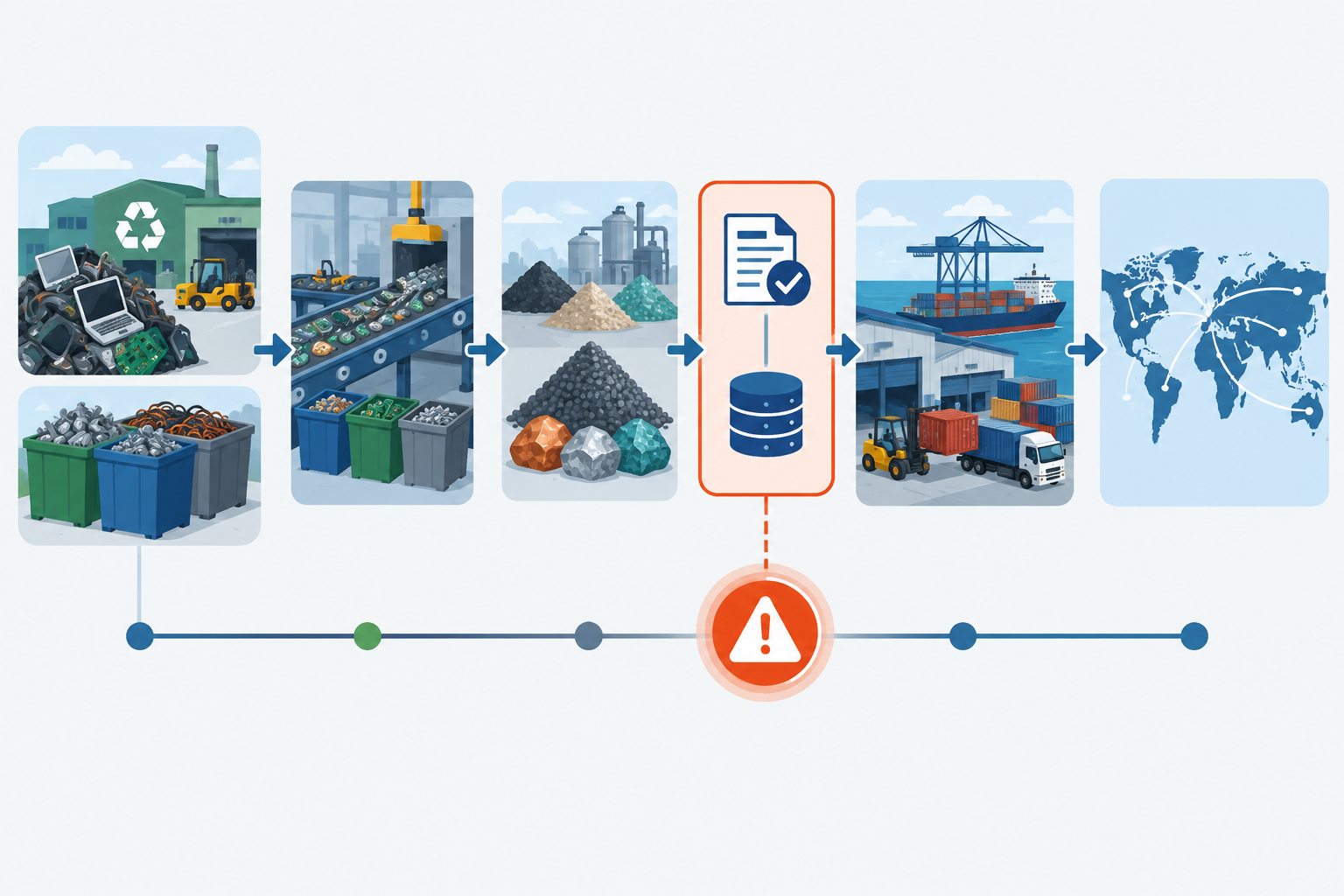
For operational planning, authorization status and transport readiness remain separate milestones. Material accumulated for an overseas refinery can remain physically in the United States while export permission is unresolved. Neither possession of the batch nor completion of its technical characterization establishes a departure date.
Domestic retention does not establish recovery capability
The rule constrains where covered feedstock can move; it does not demonstrate that every retained batch has a compatible domestic processing route. Shredding, separation, hydrometallurgical treatment and refining are distinct operating stages. A facility that produces black mass is not necessarily able to recover its constituent minerals into usable downstream products.
For a retained black-mass batch, announced projects and financing do not establish available processing capacity. Nameplate throughput—the facility’s rated capacity—also differs from actual operating production. The relevant technical question is whether an operating U.S.-located process can accept the particular feedstock and produce the intended recovered materials. Aggregate recycling-capacity descriptions can obscure that batch-level compatibility.
This distinction explains the principal recycler exposure. A business organized around domestic shredding followed by overseas refining loses the assumption that its intermediate can routinely move to the next processing stage. A domestic buyer can address the sales-allocation dimension, while the receiving site’s process capability determines whether material can actually advance through recovery.
Further domestic processing changes the classification question rather than automatically resolving it. The BIS measure addresses black mass; the export treatment of fully refined lithium, nickel, cobalt, manganese or graphite products is a separate classification issue. A downstream product route depends on both a genuine transformation of the material and the controls applicable to the resulting product.
European buyers face a second, independent compliance layer
For covered U.S. black mass, BIS authorization addresses departure from the United States. It does not replace European waste-shipment requirements. The EU Batteries Regulation, Regulation (EU) 2023/1542, links treatment of waste batteries and their fractions outside the originating Member State or outside the EU to compliance with waste-shipment rules.
From September 2026, the EU classifies black mass and specified lithium-ion battery waste as hazardous waste for shipment purposes. The European Commission’s battery-waste classification announcement connects the change with tighter shipment control and a prohibition on exports of those hazardous streams from the EU to countries outside the Organisation for Economic Co-operation and Development (OECD).
The direction of movement matters. The EU restriction on exports to non-OECD destinations is not the legal test for a shipment entering Europe from the United States. An inbound route instead combines U.S. departure authorization with the applicable European waste classification, notification, transport and receiving-facility requirements. OECD status does not remove the remaining shipment obligations.

For a European refinery purchasing U.S. black mass, the supplier’s stock record establishes physical availability, the applicable BIS authorization establishes permission to export, and the European waste-shipment documentation establishes the receiving route’s compliance. The batch description, composition and physical form need to remain consistent across the U.S. classification, authorization and European shipment records. A changed commercial label does not demonstrate that the material itself has changed.
There is also an important resource-versus-waste distinction. Black mass can contain recoverable lithium, nickel, cobalt, manganese and graphite while remaining subject to hazardous-waste shipment controls. Its usefulness to a refinery does not displace its legal waste classification. The U.S. and EU mechanisms act on the same secondary feedstock through different legal tests.
End-of-life magnet recovery requires a separate policy assessment
The cited U.S. black mass and tungsten measure does not name end-of-life permanent magnets or rare-earth magnet scrap. Permanent-magnet scrap is therefore outside this measure’s named scope, not necessarily outside every U.S. export control. Its treatment requires a separate assessment of the material’s classification and any other applicable measures.
The European Commission’s RESourceEU action plan places permanent-magnet scrap on a separate policy track. It schedules a proposal for export restrictions in the second quarter of 2026, following an assessment of international obligations and third-country partnerships. That commitment to propose measures is distinct from an operative restriction with defined customs codes, destinations and licensing conditions.
For end-of-life magnet recovery, intact magnets, demagnetized alloy, shredded magnet material and chemically processed rare-earth intermediates represent different points in the recovery chain. Their material form and classification must be assessed separately against any applicable restriction. A policy announcement alone does not assign them a common customs classification or export treatment.
The decisive signals are therefore different for the two supply chains. Black mass analysis turns on an effective U.S. rule, shipment-specific authorization and European receiving compliance. Magnet-scrap analysis turns on the material forms and jurisdictions addressed by any applicable operative measure. Treating both as a single “critical-minerals scrap ban” obscures the actual exposure.
Conclusion
U.S. critical minerals recycling export controls make jurisdiction and authorization part of covered black mass’s commercial availability, alongside chemistry and processing compatibility. Domestic retention does not establish recovery capacity, while BIS export permission does not replace European waste-shipment compliance. For magnet scrap, the named scope of the black mass and tungsten rule cannot substitute for a separate classification and export-control assessment.


