


The Propellant Bottleneck in Western Missile Production
In Western missile manufacturing, the loudest debates have focused on launchers, seekers, and guidance electronics. The actual industrial constraint is quieter and far more chemical: solid rocket motor (SRM) propellant, and specifically ammonium perchlorate (AP), now sets the upper bound on how many Tomahawk, THAAD, PAC‑3, and Standard Missiles can be produced in any given year.
The Pentagon has explicitly identified solid rocket motor propellant production as a severe constraint on munitions surge capacity. This is not a generic “capacity” issue; it is a narrow, materials-and-process bottleneck centered on AP oxidizer output and its precursors, from sodium perchlorate and perchloric acid through to qualified composite propellant batches. When this chain stalls, SRM casings, guidance kits, and warheads queue up unused.
The institutional response is equally unusual. In January 2026, the U.S. Department of Defense (DoD) executed a $1 billion convertible equity investment into L3Harris Missile Solutions, with an IPO planned for the second half of 2026. That structure breaks with decades of reliance on traditional cost‑plus and fixed‑price contracting, effectively turning missile propulsion capacity into a form of critical infrastructure financed via a hybrid public-private balance sheet.
Materials Dispatch’s view is straightforward: AP precursor chemistry, environmental permitting, and logistics – not factory headcount or assembly tooling — are now the binding constraints on Western missile surge. The L3Harris convertible is best understood as an industrial resilience instrument aimed at that specific chokepoint, rather than as a financial innovation in search of a problem.
Ammonium Perchlorate: Chemistry, Production, and Inflexible Demand
Ammonium perchlorate (NH₄ClO₄) is the dominant oxidizer in composite solid propellants used across Western tactical and strategic missile fleets. In typical hydroxyl‑terminated polybutadiene (HTPB) formulations, AP accounts for the majority of the propellant mass. It provides the oxygen needed to burn the polymer binder and metallic fuel (often aluminum) at the pressure and temperature profile required for high‑thrust, high‑specific‑impulse SRMs.
AP production follows a multi‑step chemical route:
- Chlorate/chlorite production: Sodium chlorate or sodium perchlorate is produced by electrolyzing brine solutions. This is an energy‑intensive process requiring specialized cells, corrosion‑resistant materials, and stable electricity supply.
- Perchloric acid synthesis: Sodium perchlorate is converted into perchloric acid (HClO₄), typically via ion‑exchange or reaction with mineral acids, under strict controls due to the strong oxidizing nature of the acid.
- Ammonium perchlorate crystallization: Perchloric acid reacts with ammonia to form AP, which is then crystallized, washed, and sized to meet strict particle size distributions and purity specifications for propellant formulations.
Each stage has distinct infrastructure requirements: electrolysis cells and power access at the front; glass‑lined or specialty‑metal reactors and advanced scrubbers in the middle; and crystallizers, dryers, and milling/classification systems at the back end. These facilities are subject to hazardous chemical regulations, environmental emissions limits, and explosive safety standards, making rapid greenfield build‑out difficult.
Unlike many other inputs, AP is effectively non‑substitutable for the current generation of high‑performance tactical SRMs. Ammonium nitrate and other oxidizers can support lower‑energy propellants, but they change burn rate, temperature, and impulse to an extent that would force full missile redesign and requalification. For systems such as PAC‑3 or Standard Missile interceptors, that is not a near‑term option without accepting significant performance degradation.
This is where the bottleneck becomes structural: demand for AP is relatively inelastic at the missile‑design level, while supply expansion runs into chemistry, permitting, and capital constraints simultaneously.
Program-Level Dependence: Tomahawk, THAAD, PAC‑3, and Standard Missile
The Pentagon’s concern is not abstract. The core U.S. and allied missile families that underpin both deterrence and day‑to‑day operations are all anchored on AP‑based SRMs, typically with multiple stages and, in some cases, divert and attitude control motors that further increase oxidizer demand.
- Tomahawk cruise missile: Uses solid propellant for its booster phase, bringing the missile up to speed before the turbofan cruise engine takes over. Any fourfold increase in Tomahawk output, as targeted in recent multiyear procurement plans, translates directly into a proportional increase in SRM propellant demand for boosters.
- THAAD (Terminal High Altitude Area Defense): Relies on a large single‑stage solid motor to accelerate a hit‑to‑kill interceptor to very high velocities. The motor’s propellant load is substantial, meaning even modest production increases consume significant AP tonnage.
- PAC‑3 (Patriot Advanced Capability‑3): Uses dual‑pulse motors and additional divert thrusters, all based on composite propellant. Multiyear procurement arrangements aiming at around four times baseline production multiply AP requirements across several motor types per interceptor.
- Standard Missile family (SM‑2, SM‑3, SM‑6): Incorporates solid boosters and, in some variants, solid second stages. Navy plans for expanded ship‑based air and missile defense capacity are, in practice, AP‑demand expansion plans in disguise.
In aggregate, these families tie a large share of Western military AP consumption to a relatively small number of propellant producers and precursor facilities. When Pentagon planners talk about “4x Tomahawk and AMRAAM production” under multiyear contracts, those quantities imply AP requirements that move the entire Western oxidizer market. Production targets on paper outstrip the comfortable capacity envelope of existing AP infrastructure.
The critical point is that AP demand is driven by per‑missile propellant mass and architecture, not by easily compressible overhead. No amount of assembly‑line optimization can compensate for a shortfall in oxidizer throughput; a missing guidance unit stops one missile, but a missing AP batch can stall an entire production lot.
Where the Supply Chain Fails: Geopolitics, Regulation, Logistics
Recent data on precursor sourcing and plant operations shows that three reinforcing factors — geopolitical exposure, environmental compliance, and transport frictions — are converging on AP to create a durable bottleneck.
Geopolitical Exposure in Perchlorate Precursors
AP production depends on a steady flow of perchlorate and chlorate intermediates. Market analysis indicates that roughly 30-40% of perchloric acid precursors used by Western oxidizer producers trace back to Chinese sodium perchlorate exports. That dependency was tolerable when trade was stable; it becomes a hard risk factor once export policy is weaponized.
In 2025, China imposed export controls on perchlorate‑related chemicals that broadly mirror earlier restrictions on rare earth elements. While the affected HS codes differ, the logic is similar: prioritize domestic and aligned end‑uses, scrutinize defense‑adjacent flows, and retain policy leverage over competitors’ critical materials. For Western AP producers, this has translated into a potential shortfall on the order of 5,000-7,000 metric tonnes per year of precursors relative to planned missile surge profiles.
In a market where total Western AP demand is only in the low tens of thousands of tonnes per year, losing several thousand tonnes of precursor capacity is not a marginal inconvenience; it is a systemic constraint that ripples through every missile program tied to solid propulsion.
Environmental Regulation and Utah’s Oxidizer Hub
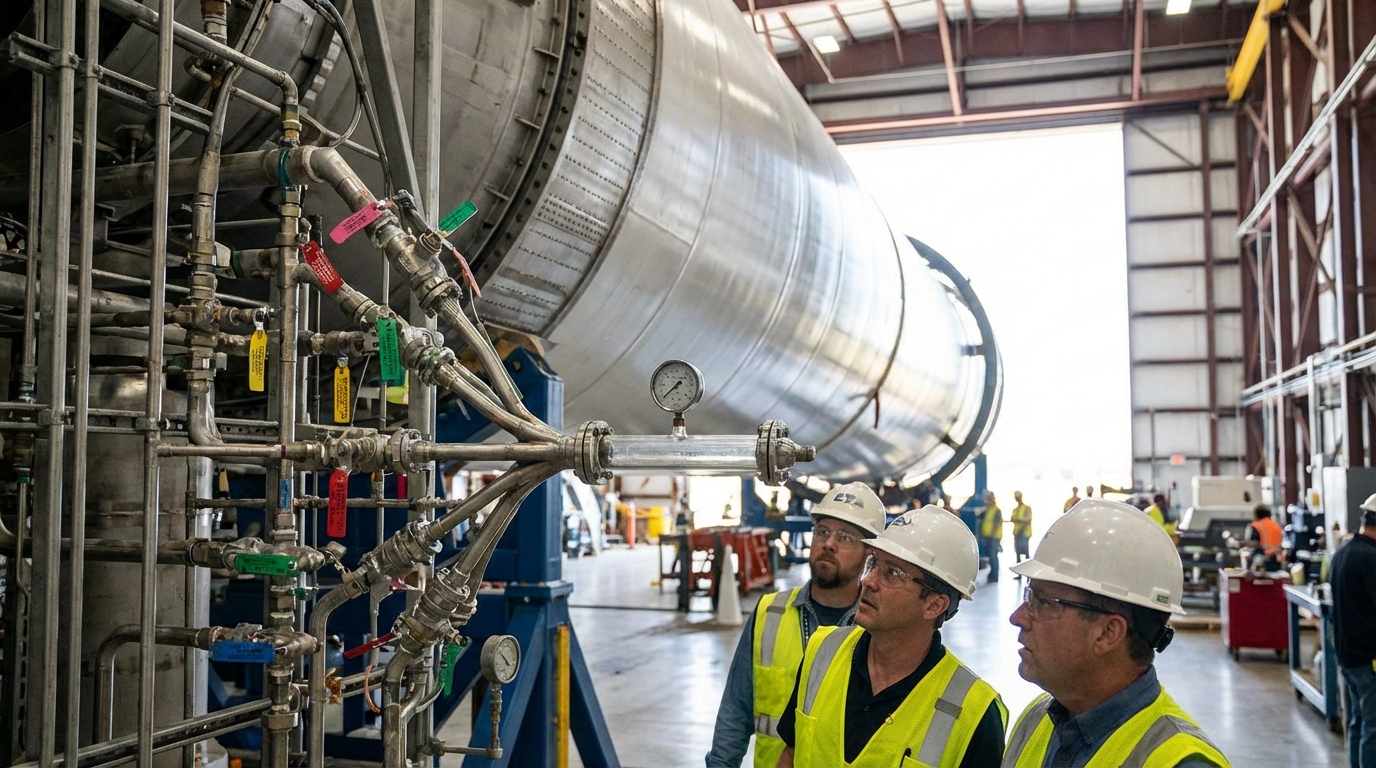
On the domestic side, the main U.S. AP production hub sits in Utah, a state facing increasingly stringent air‑quality oversight. Utah’s designation as a Class I ozone non‑attainment area has direct implications for high‑emissions chemical plants, including oxidizer facilities where chloride‑ and nitrogen‑bearing exhaust streams require advanced treatment.
Regulatory filings and industry disclosures indicate that Utah AP producers are planning scrubber and emissions‑control upgrades valued in excess of $150 million by the latter half of this decade. During retrofit windows, engineering schedules anticipate that approximately 20% of existing capacity will be idled. Even if upgrades ultimately enable higher throughput, the interim effect is fewer tonnes of qualified AP reaching SRM mixers at exactly the moment missile demand is surging.
AP plants are not trivial to re‑site. They require specialized safety arcs, water and power access, and transport links for hazardous materials. Environmental reviews, community acceptance, and explosive safety siting constraints turn every greenfield oxidizer project into a multi‑year effort, even before the first reactor vessel is poured.
Rail-Dependent Logistics and Vulnerable Corridors
The physical flow from AP crystallizer to missile motor is also fragile. U.S. AP production in Utah feeds propellant mixing and motor assembly plants concentrated in Arkansas, Alabama, and other Southern manufacturing hubs. That path runs overwhelmingly by rail, both for cost and for hazardous materials regulations that restrict long‑haul road movements of oxidizers at relevant volumes.
Typical lead times from Utah plants to SRM manufacturing centers run in the four‑to‑six week range for standard rail service. Those timings were manageable under peacetime procurement rhythms. Under surge conditions, they introduce a material delay between any change in oxidizer output and tangible relief at missile assembly lines.
The vulnerability of this corridor was made visible in 2025, when Union Pacific derailments in the western United States delayed approximately 2,000 metric tonnes of critical chemical cargoes, including AP and related materials. Even when no product was lost, cars awaiting rerouting or inspection extended delivery timelines and forced SRM plants to re‑sequence production around missing lots.
Because AP is both a strong oxidizer and an energetic material, re‑routing via ad hoc channels is rarely an option. Storage buffers mitigate these shocks only partially; a delay of a few thousand tonnes into a tightly scheduled SRM mixing calendar can translate into multi‑month gaps in downstream missile output.
DPA Title III: Necessary but Not Sufficient for Propellant Capacity
The U.S. government has not ignored the AP problem. Over several years, the Defense Production Act (DPA) Title III program has issued solicitations aimed at strengthening solid rocket motor and propellant capacity. These have supported plant modernizations, incremental capacity expansions, and in some cases new mixing and casting infrastructure.
that said, Title III is structurally optimized for marginal improvements and risk‑sharing on specific projects, not for rewiring an entire precursor value chain. Several recurring friction points have emerged:
- Project size versus cost‑share rules: Greenfield AP or chlorate plants are capital‑intensive. Title III support typically covers only a fraction of total project cost, leaving the remainder to be financed by firms that face commodity‑like pricing and concentrated offtake risk.
- Permitting timelines: Even when funding is available, environmental reviews and local permitting can run into multi‑year timeframes, particularly for projects involving perchlorates, acids, and other hazardous chemicals.
- Scope bias: Many solicitations have focused on downstream capacity (propellant mixing, motor case production, casting and cure facilities), assuming precursor supply could be managed through existing channels. The 2025 Chinese export controls and Utah regulatory tightening have shown that assumption to be fragile.
Title III remains a useful tool, especially for debottlenecking specific stages or co‑funding modernization. But as AP moved from being a manageable risk to a hard constraint, the Pentagon was left with a gap: traditional grants and cost‑share mechanisms have struggled to mobilize the scale and speed of capital required for new precursor and oxidizer capacity.
The Pentagon–L3Harris $1B Convertible: Structure and Industrial Logic
Against this backdrop, the January 2026 $1 billion convertible equity investment into L3Harris Missile Solutions represents an explicit attempt to break out of the Title III cage. Instead of adding another layer of project‑by‑project cost‑sharing, the DoD has taken a direct capital stake in a propulsion‑centric business unit, with a clear path to an initial public offering planned for the second half of 2026.
Public disclosures indicate that the instrument is structured as a convertible equity stake rather than a classic grant or loan. In practice, that means the DoD provides upfront capital in exchange for securities that convert into common equity under defined conditions, such as the planned IPO. The structure aligns several industrial‑base objectives:
- Speed of capital deployment: Unlike procurement contracts, which release cash against delivered units or milestones, and unlike Title III awards, which often require extensive cost justifications, a large convertible equity infusion can move onto a company’s balance sheet rapidly and be deployed into capex according to an integrated industrial plan.
- Risk distribution: Facility construction risk, cost overruns, and market risk are borne primarily by the corporate entity and future shareholders, not solely by the DoD. At the same time, the DoD retains leverage through its position as a major customer and convertible holder.
- Signal to private capital: A government equity stake tied to a missile‑propulsion pure‑play slated for IPO signals that AP and SRM capacity are treated as critical operational infrastructure. That signal is designed to crowd in additional private capital alongside the government’s anchor position.
- Governance access: Equity, even if structured with limited voting rights, provides more direct visibility into project pipelines, timelines, and risk than arm’s‑length contracts. That matters when AP precursor plants and motor lines become strategic assets in their own right.
From an industrial resilience perspective, the move effectively reclassifies a portion of the solid propulsion base as a quasi‑public utility. Instead of relying solely on annual appropriations and contract vehicles, the DoD now sits on the cap table of a key SRM actor, with the explicit intent of accelerating oxidizer and motor capacity build‑out ahead of confirmed unit demand.
It is also notable that the security is convertible, not perpetual common equity. That design allows eventual dilution and exit once the IPO market has absorbed the risk and once AP/SRM capacity has reached targeted levels, preserving flexibility for future policy shifts.
Execution Constraints: From Equity Infusion to Qualified Propellant
Injecting $1 billion in January 2026 does not immediately translate into more Tomahawk boosters in 2027. The solid propulsion value chain imposes real timelines between capital, concrete, and qualified propellant.
- Site selection and permitting: Any new AP or precursor facility driven by the L3Harris Missile Solutions capital will still navigate local zoning, environmental impact assessments, and explosive safety siting. Even with political support, these processes introduce unavoidable lags.
- Equipment lead times: Electrolysis cells, acid handling systems, crystallizers, and high‑energy milling equipment are specialized and often built to order. Lead times for some critical items can extend well beyond a year, especially when multiple projects compete for the same vendor capacity.
- Process qualification: Propellant‑grade AP is not a generic commodity. Any new line or plant has to demonstrate consistent purity, particle size distribution, and thermal stability. That entails extended production trials and testing campaigns with SRM integrators before full‑rate supply.
- Downstream integration: Additional AP volume only translates into missile throughput if propellant mixers, motor casting facilities, and test stands expand in parallel. DPA Title III solicitations have already targeted some of these stages, but they remain coupled to precursor availability.
This is where the IPO timeline becomes relevant. With an H2 2026 listing planned, L3Harris Missile Solutions is effectively using the DoD’s convertible as bridge capital to fund early design, permitting, and long‑lead equipment commitments, while expecting public‑market proceeds and follow‑on debt to finance later construction phases and downstream integration.
The critical execution risk is sequencing. If precursor plant projects slip due to permitting or equipment delays, while downstream mixing and motor lines come online on time, the system simply shifts the bottleneck further upstream. Conversely, if AP capacity is ready but shipping and storage constraints lag, oxidizer can accumulate at origin without reducing lead times into SRM plants.
Scenarios 2026–2030: Surge, Shortfall, and Stockpile Tradeoffs
Considering AP precursor risks, DPA initiatives, and the L3Harris convertible, three broad industrial scenarios frame the 2026–2030 window.
1. Managed Surge: Incremental Debottlenecking and Staggered Capacity
In a managed surge scenario, existing AP facilities in Utah complete environmental upgrades broadly on schedule, with only the anticipated 20% temporary capacity idling. Alternative precursor sources partly backfill the loss of Chinese sodium perchlorate, keeping the net shortfall closer to the lower end of the 5,000–7,000 tonne band.
The L3Harris Missile Solutions capital programme brings incremental new AP and mixing capacity online toward the end of the decade, while DPA Title III projects deepen redundancy in SRM mixing and casting. Under this trajectory, fourfold missile production targets for Tomahawk and AMRAAM are not fully met, but output steps up substantially relative to the pre‑2022 baseline, with most delay attributable to qualification and logistics rather than absolute chemical scarcity.
2. Hard Constraint: Regulatory Slippage and Precursor Shock
A harder‑constraint scenario emerges if environmental permitting for expansions stretches out, local opposition slows new oxidizer projects, or if Chinese export controls tighten further or are mirrored by other precursor‑producing states. Under that pattern, the upper end of the 5,000–7,000 tonne precursor shortfall materializes or is even exceeded.
In this case, the L3Harris convertible still underwrites critical new infrastructure, but the practical impact shifts into the 2029–2030 window. Missile programmes face binding AP rationing, with program offices trading production slots between fleets. Stockpiles of already‑cast motors become a key tool for buffering shocks, but replenishment cycles lengthen.
From a technical standpoint, propellant formulators may be forced to explore higher‑risk substitutions or process adjustments to stretch available AP, but any such moves carry qualification and reliability implications that weapon‑system integrators treat with justified caution.
3. Overbuild and Latent Capacity: Equity Pulls Forward the Curve
A more optimistic scenario sees the $1 billion convertible acting as a catalyst that overbuilds oxidizer capacity relative to immediate procurement plans. If permitting proceeds smoothly and IPO markets accept L3Harris Missile Solutions at favorable terms, the company and its ecosystem could end the decade with substantial latent AP and SRM capacity.
In that world, the structural bottleneck might migrate away from oxidizer to other inputs — for example, specific alloys for motor cases or nozzle components, or highly specialized test and inspection equipment. But even in that case, the AP constraint will not have vanished; it will have been displaced by concerted industrial policy and financing, not by organic market dynamics.
Historical Echoes: From Shuttle Boosters to Today’s Industrial Base
The present AP bottleneck has historical analogues. During the Space Shuttle era, solid rocket boosters relied on large composite propellant segments that concentrated oxidizer demand in very few facilities. Accidents, quality‑control issues, and local regulatory pressures highlighted how vulnerable a launch system could be to a single propellant line or plant.
There is also a broader echo in other critical materials episodes, such as earlier depletion scares in hydrazine propellants or the post‑Cold War contraction of nitrate‑based explosives capacity. In each case, military programmes assumed the continued availability of legacy chemical infrastructures long after commercial markets had moved on or consolidated.
What distinguishes the current AP situation is the combination of three factors rarely seen together:
- Geopolitical contestation over upstream precursors, including export controls shaped explicitly with defense end‑uses in mind.
- Domestic environmental tightening in precisely the regions where legacy oxidizer plants are located, forcing costly retrofits and threatening local social licence.
- Financial innovation in the form of direct government convertible equity, taking the industrial base partly outside the traditional procurement and grant toolkit.
This combination makes the AP case a template for how other defense‑critical chemicals and materials may play out in coming years: a small number of chokepoints, magnified by geopolitics and regulation, addressed via hybrid public–private capital structures rather than purely contractual remedies.
Synthesis: What Really Constrains the Next Missile Surge
For defense industry analysts, propulsion engineers, and munitions‑supply specialists, the core insight is that the limiting factor in Western missile surge capacity is no longer assembly‑line footprint or even warhead manufacturing. It is the ability to source, process, and deliver consistent, qualified batches of ammonium perchlorate and its precursors under tightening regulatory and geopolitical conditions.
Tomahawk, THAAD, PAC‑3, and Standard Missile programmes are all effectively indexed to AP throughput. Multiyear procurement contracts targeting fourfold production increases represent an intention; AP and precursor capacity determine how much of that intention can translate into fielded hardware, and on what timeline.
DPA Title III solicitations have played an important role in sustaining this ecosystem, but their design is inherently incremental. The Pentagon’s $1 billion convertible equity stake in L3Harris Missile Solutions, with an H2 2026 IPO in view, signals recognition that the oxidizer bottleneck is a structural industrial‑base issue requiring a different toolset.
From Materials Dispatch’s perspective, three trade‑offs define the space over the next decade:
- Speed versus governance: Direct equity accelerates capital deployment but draws the DoD closer to corporate decision‑making and market volatility.
- Redundancy versus cost: Building surplus AP and SRM capacity enhances resilience but risks under‑utilization in peacetime and political scrutiny over “excess” capability.
- Environmental compliance versus concentration: Upgrading and expanding legacy plants in regulated jurisdictions trades single‑site risk against the complexity of siting new facilities elsewhere.
The outcome will depend less on abstract budget levels and more on the execution of specific chemical plants, rail corridors, and qualification programmes. Materials Dispatch is actively monitoring weak signals across these domains — from precursor export‑control notices and Utah air‑quality rulemakings to Title III solicitation language and L3Harris Missile Solutions’ pre‑IPO disclosures — because those are the levers that will ultimately determine how many missiles Western arsenals can credibly field under surge conditions.
Note on Materials Dispatch methodology Materials Dispatch combines close reading of official industrial‑base reports, export‑control filings, and DPA Title III documentation with tracking of corporate disclosures from firms such as L3Harris, as well as technical specifications for missile propulsion systems. This triangulation between policy texts, market data, and end‑use engineering requirements underpins the assessment of where bottlenecks are truly emerging in AP and solid rocket motor supply chains.


