
Uncategorized
Donald’s A$180m Approval Puts Rare-Earth Processing in Focus


Australian agencies conditionally approved up to A$180 million for Donald’s first phase on 26 October 2026. The approvals advance the proposed financing, but its rare-earth supply contribution would depend on converting Australian concentrate into separated oxides in Utah.
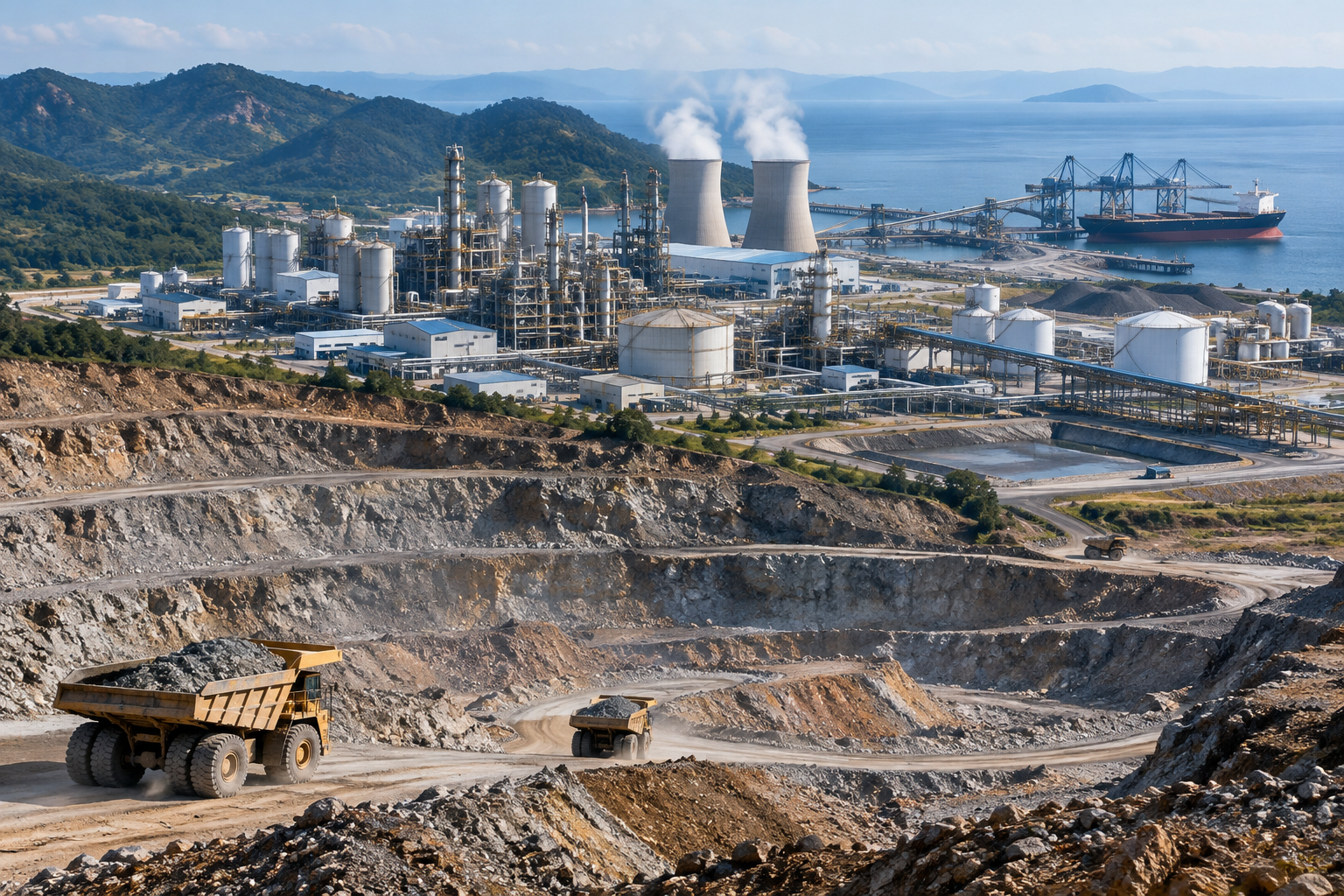
Astron Corporation Limited’s Donald Rare Earth and Mineral Sands Project in northwest Victoria, Australia, is being developed around two product streams and a cross-border processing partnership. Its mineral-sands concentrate would serve global customers, while its rare-earth-enriched concentrate would go to partner Energy Fuels Inc.’s White Mesa Mill in Utah for chemical processing and separation. Donald remains a development project, rather than an operating source of either product.
On 26 October 2026, Energy Fuels announced conditional credit approvals from Export Finance Australia (EFA) and the National Reconstruction Fund Corporation (NRFC) for up to A$180 million, presented as US$126 million, towards Phase 1. The proposed government loans would anchor an A$200 million senior project-finance debt facility.
This is meaningful progress towards financing an integrated Australia-United States supply chain. Its strategic value, however, must be assessed through the ability to turn Donald’s concentrate into marketable separated oxides. Mine financing and downstream processing are parts of the same commercial case: an Australian production target has limited significance for rare-earth supply unless the Utah conversion route can deliver the intended products.
What the proposed debt would finance
The proposed facility comprises up to A$70 million from EFA, up to A$110 million from NRFC and approximately A$20 million from commercial lenders. Reporting on the financing terms puts the government loans’ proposed tenor at 10 years from financial close, with interest based on the Bank Bill Swap Bid Rate, an Australian floating-rate benchmark, plus a margin. This is repayable debt, not an equity grant.
The facility is intended to cover Phase 1 construction, commissioning, financing costs and operating costs during ramp-up through project completion. That scope matters because the financing must support the transition from building assets to generating operating cash. Early production, recovery and processing performance therefore affect the financing case, rather than becoming relevant only after construction ends.
The approvals remain conditional on due diligence, definitive documentation, final approvals, commercial-lender participation and satisfaction of financing conditions, as described in reporting following the announcement. They do not constitute financial close or funding available for drawdown. Astron and Energy Fuels were targeting a final investment decision in the fourth quarter of 2026, subject to completing the financing package. The A$200 million proposal should consequently be understood as a planned debt component, rather than evidence that Phase 1 is fully funded.
The product distinction changes the supply calculation
Energy Fuels’ October announcement projects average Phase 1 production of approximately 9,000 tonnes per annum of rare-earth-enriched concentrate, or REEC, and 225,000 tonnes per annum of heavy mineral concentrate, or HMC, over a planned 40-year mine life. REEC contains rare-earth-bearing monazite and xenotime; HMC contains zircon and titanium dioxide minerals. These are separate product streams, and neither figure represents separated rare-earth oxide production.
The planned White Mesa route would process Donald’s approximately 9,000 tonnes of annual REEC into roughly 1,000 tonnes per annum of neodymium-praseodymium oxide, known as NdPr oxide, together with terbium and dysprosium oxides. These elements are used in permanent-magnet supply chains. The concentrate tonnage includes material other than the target elements, while chemical processing separates individual products. The two tonnage figures therefore cannot be treated as interchangeable, or their ratio as a simple processing-recovery rate.
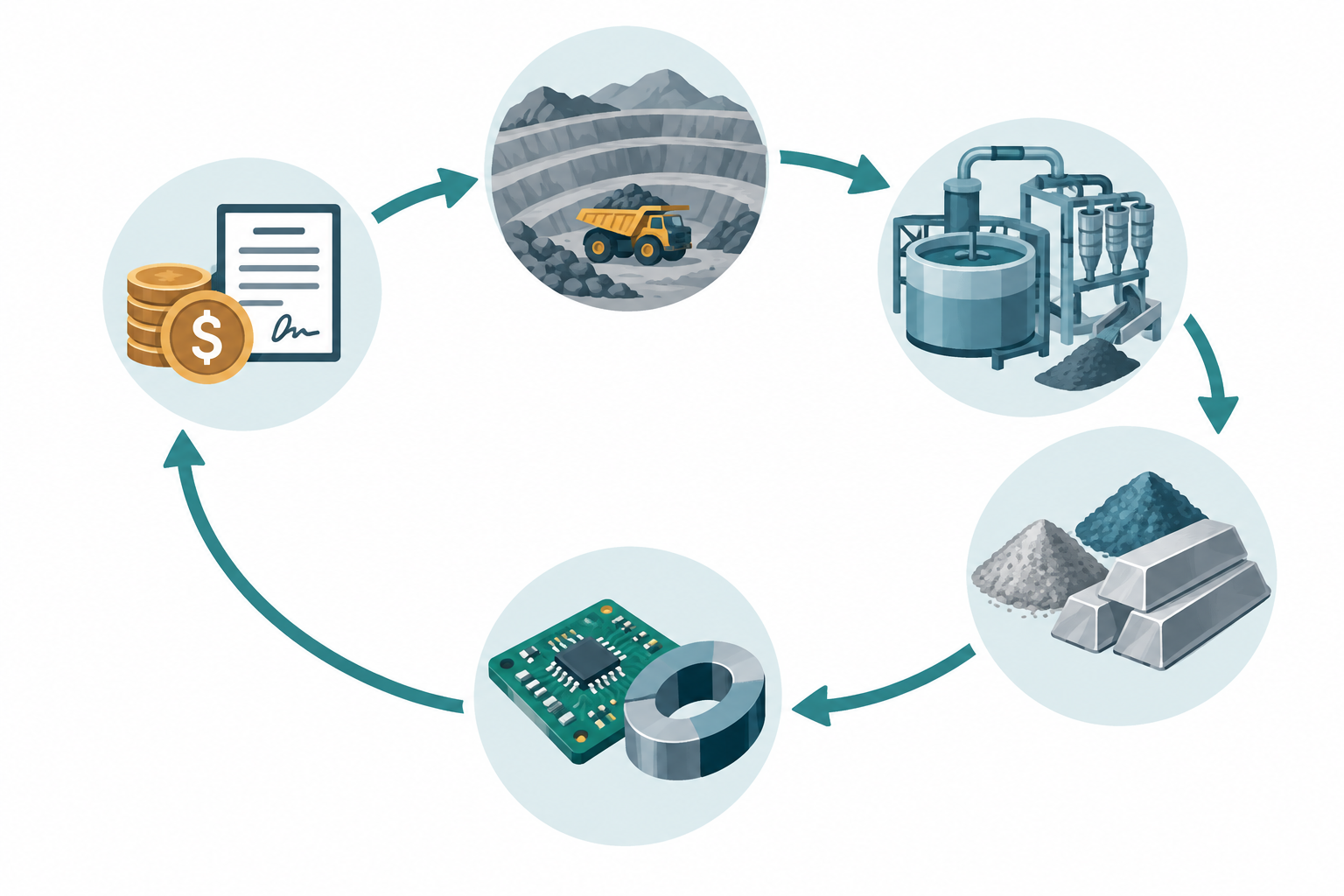
Under the planned joint-venture arrangements described by Energy Fuels, Energy Fuels is expected to purchase all REEC, while Astron is expected to purchase all HMC for sale to global customers. This gives each stream an identified commercial route. It also means Donald’s direct product is concentrate: the value of downstream oxides would affect the mine through its concentrate-sale terms, processing economics and the buyer’s ability to sustain that route. Applying a separated-oxide or metal price directly to REEC tonnage would misstate the project’s revenue basis.
White Mesa strengthens the case — and concentrates execution risk
The strongest counterargument is that a downstream-focused assessment could understate the execution advantage of Donald’s identified processing partner and existing US separation platform. The proposed route does not require an entirely new rare-earth separation plant at the Australian mine. In its June 2024 project description, Energy Fuels described White Mesa’s circuit as designed for up to 10,000 tonnes per year of monazite-sand feed and up to 1,000 tonnes per year of NdPr oxide. Using an existing platform could reduce greenfield construction risk, while leaving Donald-specific integration and operating performance to be demonstrated.
Those design figures do not, by themselves, establish capacity for Donald’s latest production plan. The earlier feed-capacity figure was expressed in monazite sand, whereas Donald’s current output is expressed as REEC containing monazite and xenotime. Feed mineralogy, impurities, radionuclide content, moisture and variability influence processing performance. Compatibility between Donald’s concentrate and White Mesa’s flowsheet — the sequence of chemical treatment and separation steps — is consequently more important than the apparent numerical proximity of 9,000 and 10,000 tonnes.
Product readiness also differs across the chain. Energy Fuels says it is installing terbium and dysprosium separation circuits at White Mesa, with commissioning expected in early 2028. Those planned heavy-rare-earth capabilities are distinct from the existing NdPr platform and from Donald’s targeted investment decision. An integrated assessment must preserve those differences rather than presenting all intended oxide products as equally available.

The resulting execution risk spans the planned Australian operation, White Mesa and the transport link between them. Australian mine and concentrator performance would need to align with shipment schedules, White Mesa availability, chemical recoveries and product qualification. Donald could reach its concentrate-production target while the wider chain underperforms commercially if transport or separation restricts throughput. Conversely, successful processing at White Mesa would give the Australian project access to a downstream capability that mine finance alone cannot create.
The commercial test hinges on conversion
The conditional credit approvals have value because they advance financing for the upstream portion of a defined, planned processing chain. The mineral-sands stream also gives Donald a separate prospective commercial product alongside its rare-earth feed. These features distinguish the project from a mine proposal without an identified processing destination.
The remaining judgement turns on whether that chain can operate on compatible technical and commercial terms. Concentrate-sale revenue, transport and treatment costs, recoveries and downstream product specifications would determine how separated-oxide value supports the mine’s cash generation. A planned 40-year mine life cannot substitute for dependable cash flow during a proposed 10-year debt term beginning at financial close. Donald’s strongest case is the combination of an Australian feed source and an existing US processing platform. If the financing conditions are satisfied and the partners reach their targeted fourth-quarter 2026 investment decision, the next test would be executing that integrated route at commercial rates.
