
Case Study
Mapping the Entities Behind Critical-Mineral Export Risk


A rare-earth magnet shipment can carry a certificate of origin, an invoice from a distributor and shipping instructions naming a different exporter. None of those differences, by itself, establishes a breach. Together, they reveal why a material-origin check cannot resolve the export-control exposure of the transaction.
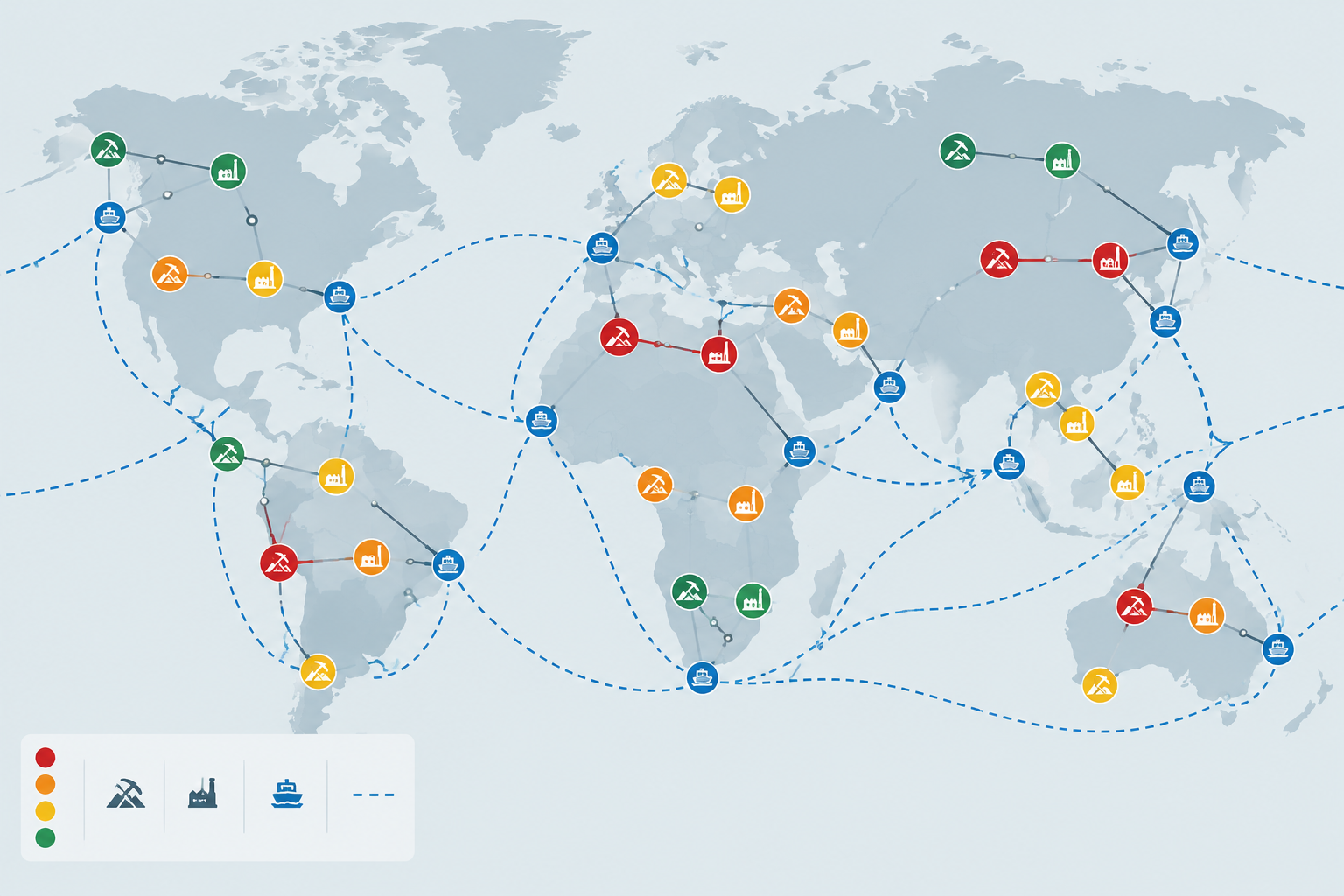
Supply chain exposure mapping connects the material to the legal entities that process, own, finance, store, route and receive it. The relevant unit is not simply “dysprosium,” “magnet” or “non-Chinese material.” It is a particular product moving through identified entities and sites, under a particular jurisdiction, classification, authorization and end-use declaration.
- A certificate of origin records a customs-origin conclusion; it does not identify every separator, alloy producer, technology provider or intermediary.
- A direct supplier with no name-screening match can still have exposure through a parent, manufacturer, site operator, address or end user.
- Ownership thresholds, product controls and military-end-use restrictions are separate tests with different legal scopes.
- A changed exporter, processing site, owner, route or destination can invalidate the assumptions behind an earlier supplier assessment.
The mapping boundary extends beyond the tier-1 seller
The tier-1 purchase record identifies the commercial relationship, but not necessarily the production chain. A distributor may invoice material made at several plants; a toll processor may operate a facility owned by another company; a logistics provider may introduce an additional warehouse or customs declarant. Each relationship adds a distinct identity and role to the exposure map.
For separated rare earths, the map connects the feedstock source, concentrate seller, separation plant, oxide producer and exporter. For metals, alloys and permanent magnets, it extends through reduction, alloying, powder production, magnet manufacture, coating and assembly, where those stages occur. Tier-2 supplier mapping follows the actual process rather than stopping at the distributor’s immediate supplier.
The minimum useful record links the legal entity, branch, address, beneficial owner, intermediary, manufacturing site, logistics provider, end user and end-use declaration to the material, product code, shipment and jurisdiction. An entity can hold several roles, but the roles remain distinguishable: seller, manufacturer, exporter of record, shipper, consignee and final user are not interchangeable descriptions.
Identity resolution uses registered names, registration numbers, registered and operating addresses, former names and original-script names alongside transliterations. A brand name alone leaves the legal counterparty unresolved. Site records identify both the owner and operator, because neither necessarily matches the company issuing the invoice.
Jurisdiction, rule version and transaction scope remain separate
The U.S. Bureau of Industry and Security’s Entity List framework imposes specified licensing requirements on exports, reexports and in-country transfers of items subject to the Export Administration Regulations, or EAR, involving listed parties. It is not a universal prohibition on every transaction involving every listed organization. The item’s jurisdiction, the party’s role and the applicable entry determine the analysis.
BIS’s November 6, 2024 guidance also addresses listed addresses and makes clear that military-end-user analysis extends beyond names on a list. An unlisted entity can meet the military-end-user definition under EAR §744.21(g). Consequently, a name-screening result does not settle an end-use assessment.
Ownership introduces another layer. In its September 29, 2025 announcement, BIS described an affiliate rule extending Entity List and Military End User List restrictions to entities owned at least 50%, individually or collectively, by listed entities. The announcement also identified significant minority ownership as a red flag. These are distinct concepts: a threshold calculation and an assessment of influence below that threshold.

For transaction analysis, the ownership calculation attaches to the applicable rule version and effective date. Publication, commencement, amendment and any suspension occupy separate fields in the regulatory record. A dated announcement is not interchangeable with the legal position governing a later shipment, and the same ownership threshold cannot simply be transferred between jurisdictions or control regimes.
China’s Ministry of Commerce and General Administration of Customs announced controls on April 4, 2025 covering specified items involving samarium, gadolinium, terbium, dysprosium, lutetium, scandium and yttrium. The announcement’s item definitions, rather than the element name alone, establish product scope. Separately, MOFCOM’s October 9, 2025 Announcement No. 62 addressed specified rare-earth-related technologies. These instruments illustrate why product and technology exposure occupy separate parts of the map.
A designation such as “ex-China” so answers only part of the sourcing question. Processing location, technical assistance, technology access, ownership and transaction parties remain relevant to their respective legal tests. EU and UK sanctions and export-control exposure likewise remain separate jurisdictional assessments where applicable; a U.S. screening result does not resolve them.
Written disclosures connect the supplier story to shipment evidence
A useful supplier questionnaire produces relationships that can be reconciled across corporate, technical and shipping records. A general statement that material is “not controlled” lacks the detail needed to connect a classification conclusion to a particular product, manufacturer and transaction.
- Entity and site allocation: the written response identifies each company invoicing, manufacturing, processing, storing, exporting, brokering or delivering the material, with registration details and the legal operator of each facility.
- Ownership and influence: the ownership chart includes intermediate holding companies, direct and indirect interests, ultimate beneficial owners, voting rights, board appointment rights and relevant joint-venture or management relationships. Percentage ownership and control rights appear separately.
- Processing history: the site schedule distinguishes extraction, concentration, separation, refining, alloying, powder production, magnet manufacture, recycling and packaging, as applicable. Batch or lot references connect the supplied material to those locations.
- Classification and technology: the response records the product’s technical description, customs Harmonized System code, EAR jurisdiction and Export Control Classification Number — or EAR99 designation where applicable — with the basis for that assessment. Controlled technology, software and technical assistance receive separate treatment.
- Route, destination and authorization: shipping records identify the exporter, forwarder, warehouses, transit points, consignee and final user. License records capture the issuing authority, validity, item coverage, quantity, destination and named parties.
- Change history: dated disclosures explain changes in owner, bank account, manufacturing site, exporter, route, product code and end user, alongside the supplier’s arrangements for communicating subsequent changes.
The documents answer different questions. A registry extract supports entity identity and disclosed ownership. A bill of lading records a transport movement. An end-use statement identifies the declared use and user. None substitutes for the others. Similarly, an HS code is a customs classification, not a determination of EAR jurisdiction or an ECCN.
Disclosure gaps also have different meanings. A missing manufacturer prevents site-level assessment; a missing intermediate holding company prevents a complete ownership calculation; an unsigned or generic end-use statement weakens the connection between the consignee and declared application. Treating all three as a single “incomplete questionnaire” status obscures the actual failure mode.
Illustrative case: origin screening passes, counterparty exposure changes
The following document test is illustrative, not an account of a named supplier. It follows a permanent-magnet purchase initially assessed through the tier-1 distributor’s material-origin declaration. The useful discovery occurs when technical, corporate and shipping records are compared — not when the origin declaration is read in isolation.
| Document finding | Exposure revealed | Effect on the assessment |
|---|---|---|
| The technical record identifies a magnet plant absent from the distributor’s site disclosure. | An additional manufacturer and site operator enter the chain. | The earlier assessment did not cover the actual manufacturing entity or its ownership. |
| The plant’s ownership chart identifies a listed affiliate behind an intermediate holding company. | The relationship introduces an ownership and control question. | The relevant holdings, control rights and transaction-date rule determine the consequence; the affiliate relationship alone does not answer it. |
| The shipping instruction names a different exporter of record. | A new transaction participant appears after supplier onboarding. | Party screening and any license coverage depend on the exporter actually used. |
| The final destination differs from the signed end-use statement. | The declared route, recipient and end use no longer form a consistent record. | The earlier end-use assessment no longer describes the proposed movement. |
The origin declaration can remain accurate throughout this example. The failure lies in treating it as evidence about parties, ownership and destination that it never described. Source requalification concerns the changed supply configuration, not an automatic conclusion that the material’s origin was misdeclared.
Requalification follows changed assumptions, not only new material
A supplier exposure assessment loses relevance when its underlying configuration changes. Requalification triggers include a renamed entity, new shareholder, different site operator, substituted toll processor, new exporter, changed transshipment route, revised product specification or different final user. A regulatory update can also change the significance of an otherwise unchanged relationship.
Document inconsistencies provide more specific signals. A generic invoice description such as “metal products” may fail to describe the rare-earth alloy or powder shown in technical records. An unexplained HS-code change can indicate inconsistent classification. A new bank, exporter or consignee in an unrelated jurisdiction introduces an additional relationship whose role is absent from the existing record. These are assessment triggers, not findings of evasion.
Ownership opacity is a separate trigger. A chart omitting intermediate companies prevents aggregation of relevant holdings. A minority interest with board representation or veto rights presents a different question from a passive holding. Corporate registries may not disclose nominee arrangements, voting agreements or every form of operational influence, so a registry search and a control assessment are not equivalent.
Distributor inventory creates a further boundary: qualification of one plant does not automatically characterize every lot sold under the same trade name. Where exposure depends on the manufacturer or processing source, lot-level records connect the shipment to the assessed chain. The same distinction applies to blended feedstock and recycled material, whose collection, preprocessing, refining and export participants remain part of the map.
Response paths carry different continuity and traceability tradeoffs
An unresolved relationship does not produce the same operational response in every case. The response depends on whether the gap concerns identity, ownership, classification, authorization or the physical supply configuration.
| Response path | What it addresses | Boundary or tradeoff |
|---|---|---|
| Document reconciliation | Differences among the questionnaire, ownership chart, site list and shipment records. | Can resolve inconsistent records without changing the physical source, but cannot remove a restriction that applies to the actual transaction. |
| Site- and lot-specific qualification | Mixed distributor inventory or incomplete attribution to a manufacturer. | Improves traceability for the identified supply stream without extending that assessment to every plant or batch. |
| Specialist ownership or classification review | Indirect holdings, control rights, military-end-use indicators or technical classification ambiguity. | Addresses the legal question but does not substitute for missing corporate or technical evidence. |
| Transaction-specific release hold | A new party, route, end user or classification introduced before shipment. | Interrupts movement while the changed transaction is assessed; a pause alone does not establish that an alternative configuration is permissible. |
The auditable result is a dated transaction map
The resulting record links entity, role, ownership, site, material, classification, jurisdiction, license, route and end user, with effective dates and supporting documents. Parent, subsidiary, branch, former-name and address relationships retain their history rather than disappearing when a supplier profile changes.
Screening records preserve the search date, list version, query terms, transliterations and disposition of possible matches. “No match found,” “not screened” and “ownership unresolved” are different outcomes. Keeping them distinct prevents a blank result from becoming an apparent clearance.
Commercial onboarding and export-control assessment also remain separate statuses. An approved distributor can supply a shipment involving a different manufacturer, exporter or end user from the one previously assessed. The operational output is therefore a dated map of the specific supply configuration, with visible gaps and requalification triggers — not a permanent low-risk label attached to a material or vendor.


