
Data Brief
Why Heavy Rare Earth Prices Differ by Market and Contract


Heavy rare earth prices form through bilateral trade and specialist assessments, not a single global exchange benchmark. For procurement, product specification, contract terms and deliverability determine whether a published price is a useful reference.
A usable heavy rare earth quotation identifies the product, purity, currency, unit, location, delivery terms and observation date. Without those fields, the difference between two quotations may reflect different delivery obligations or material specifications rather than a change in market value.
The commercial focus is dysprosium and terbium, additives used in high-performance neodymium-iron-boron permanent magnets. Their pricing is particularly sensitive to the availability of material that a buyer can actually use: the correct chemical form and quality, accepted by the customer and deliverable to the required jurisdiction.
How trades become a rare earth price benchmark
Producer offers, negotiated spot transactions and confidential long-term contracts form the underlying market. Specialist price assessments provide a reference for that trade, but individual rare earth oxides have no single exchange-traded global benchmark equivalent to COMEX copper, as described in Farmonaut’s rare-earth market overview. A published assessment and a buyer’s contract price therefore answer different questions: one describes an assessed market range; the other establishes the price payable under specific commercial obligations.
Fastmarkets’ assessments launched in March 2026 illustrate the importance of specification. They included weekly assessments for dysprosium oxide at 99.5% purity, ferro-dysprosium alloy at 80% dysprosium, and terbium oxide at 99.99% purity, quoted in US dollars per kilogram on a CIP-global basis. CIP means Carriage and Insurance Paid To a named destination; it is not equivalent to a duty-paid quotation.

That price assessment methodology combines completed transactions with bids, offers and broader market intelligence when direct trading evidence is insufficient. A transaction-only index could otherwise remain unchanged simply because no comparable trade occurred. The assessment maintains a reference range, but it is neither an exchange settlement nor a guarantee that a particular volume can be bought at every point within that range.
Differences between assessments can also reflect observation dates, product specifications and treatment of commercial terms. Multiple published price points do not necessarily represent multiple independent pools of physical liquidity.
Why dysprosium and terbium prices can move sharply
Dysprosium and terbium serve a narrower group of applications and qualified buyers than praseodymium-neodymium, the core magnet constituents commonly traded as PrNd. In a small spot market, one qualified transaction or firm offer can move the observable range substantially because there are few comparable trades. Fastmarkets’ accompanying 2026 market description put China’s share of heavy rare earth supply at roughly 95%, adding geographic concentration to thin market pricing.
Demand is difficult to substitute quickly. Reducing dysprosium or terbium can affect coercivity — the magnet’s resistance to demagnetisation — and high-temperature performance. Changing a formulation can require redesign and customer qualification. A buyer facing a production interruption therefore cannot necessarily switch material in response to a higher quotation.
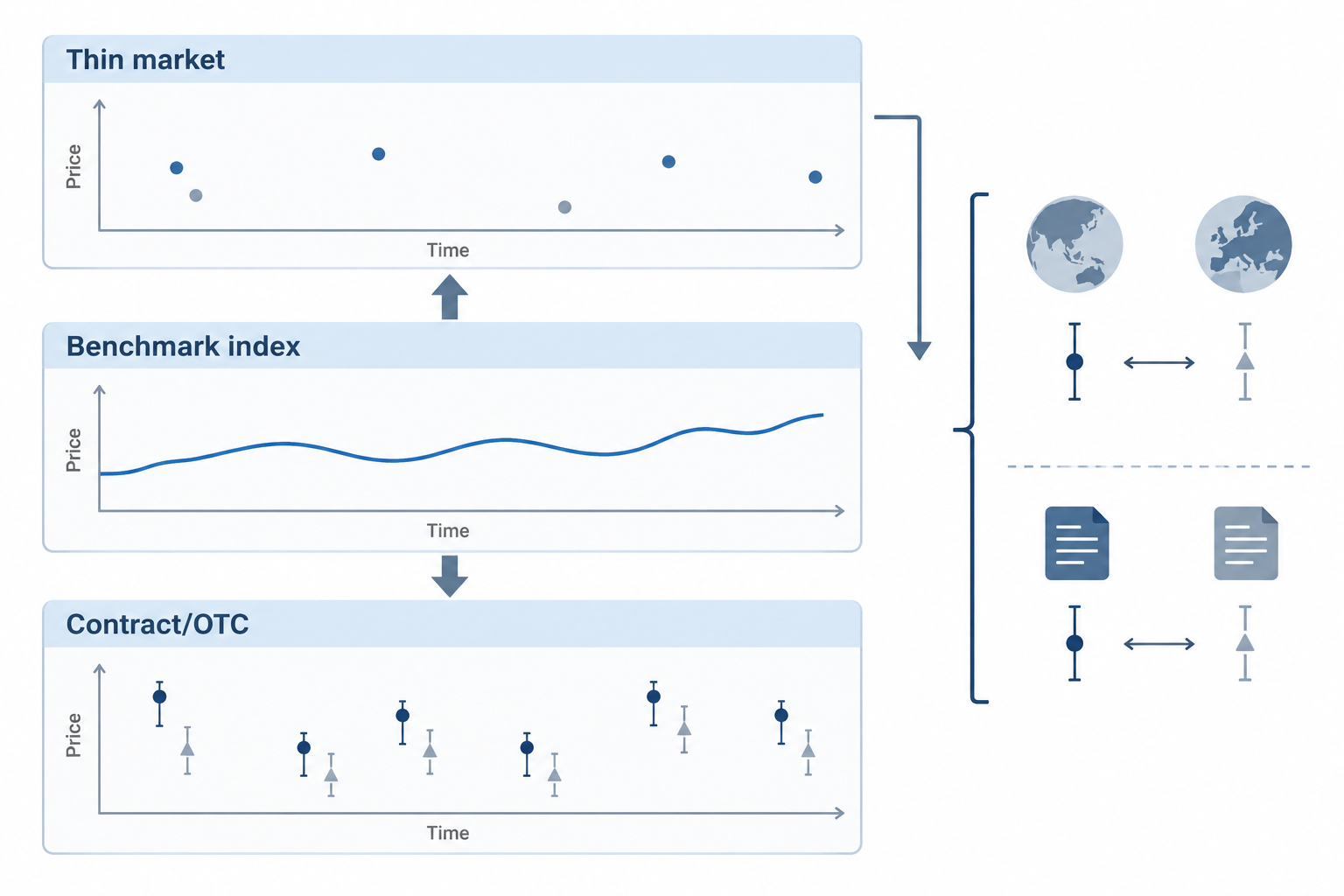
Long-term agreements further reduce the volume visible in spot trading. Fixed prices, formula pricing, floors, ceilings and delayed resets can insulate contracted purchases from immediate spot movements. But contract expiry, renegotiation or a delivery shortfall can bring several buyers into the residual spot market together. Terbium price volatility can therefore reflect the timing of procurement as well as changes in total consumption.
Chinese inventories provide another buffer. Releases by refiners, traders, magnet manufacturers or strategic stockholders can increase immediately available supply; withholding or rebuilding those stocks can tighten it without any change in mine output. Mine production alone therefore does not describe the short-term balance: stockholders’ willingness and ability to sell also determine spot availability.
Why Chinese and offshore prices can separate
China introduced case-by-case export licensing for seven medium and heavy rare earths, including dysprosium and terbium, on April 4, 2025. This created an additional distinction between material physically held in China and material available for overseas delivery. Domestic inventory may lack an export licence, fail an overseas customer’s specification or be held by an owner unwilling to sell offshore.
Consequently, an offshore premium can reflect access to licensed, traceable and deliverable material rather than a different estimate of mining costs. Chinese domestic prices can fall while offshore prices rise if domestic availability expands but exportable supply remains constrained. These are separate physical markets, not contradictory quotations for freely interchangeable inventory.

Late August 2026 indications from Fastmarkets, cited by Business Insider, placed dysprosium oxide at approximately US$270–330/kg inside China versus US$1,250–1,675/kg outside China, and terbium oxide at US$1,180–1,270/kg versus US$4,200–5,000/kg respectively. These historical indications are not current quotations or a fully matched comparison of purity, lot size, payment terms and delivery obligations. Their difference cannot be treated entirely as an export-licensing premium or reduced to a universal offshore multiplier.
Matching an assessment to a supply contract
Reconciling an assessment with a supply contract involves the assessment specification and methodology, the supplier’s quotation, the material and delivery requirements, and the contract’s pricing clause. Five considerations explain most of the potential differences:
- Product equivalence: Oxide, metal and alloy prices describe different products. Dysprosium oxide at 99.5% purity and ferro-dysprosium at 80% are not directly comparable per kilogram; contained dysprosium, conversion costs and commercial terms differ.
- Market access and delivery: The named destination, freight, insurance, duties and export eligibility determine whether the reference covers the same deliverable supply. A Chinese domestic quotation is not automatically an available purchase price for an overseas customer.
- Evidence behind the range: The assessment methodology explains how completed trades, bids, offers and other market information contribute to the reference. A small urgent parcel may carry different terms from a routine contract-sized shipment.
- Timing and units: Observation periods, currencies and quantity units affect comparability. Yuan-per-tonne and dollar-per-kilogram quotations require a common currency and unit before a price difference can be calculated.
- Contract transmission: The pricing clause establishes which assessment applies, the averaging period or reset date, and any premium, floor, ceiling or delivery adjustment. Those provisions determine how much of a benchmark movement reaches the invoice.
A reconciled comparison connects the applicable assessment to the quoted or invoiced price through those commercial adjustments. Qualification, guaranteed delivery and parcel size can explain differences that would otherwise be labelled general market inflation. Where specification or delivery basis cannot be aligned, the quotation remains a separate market observation, not evidence of a like-for-like price change.


