
Sentiment Analysis
How to build an internal ‘materials war room’ for your company


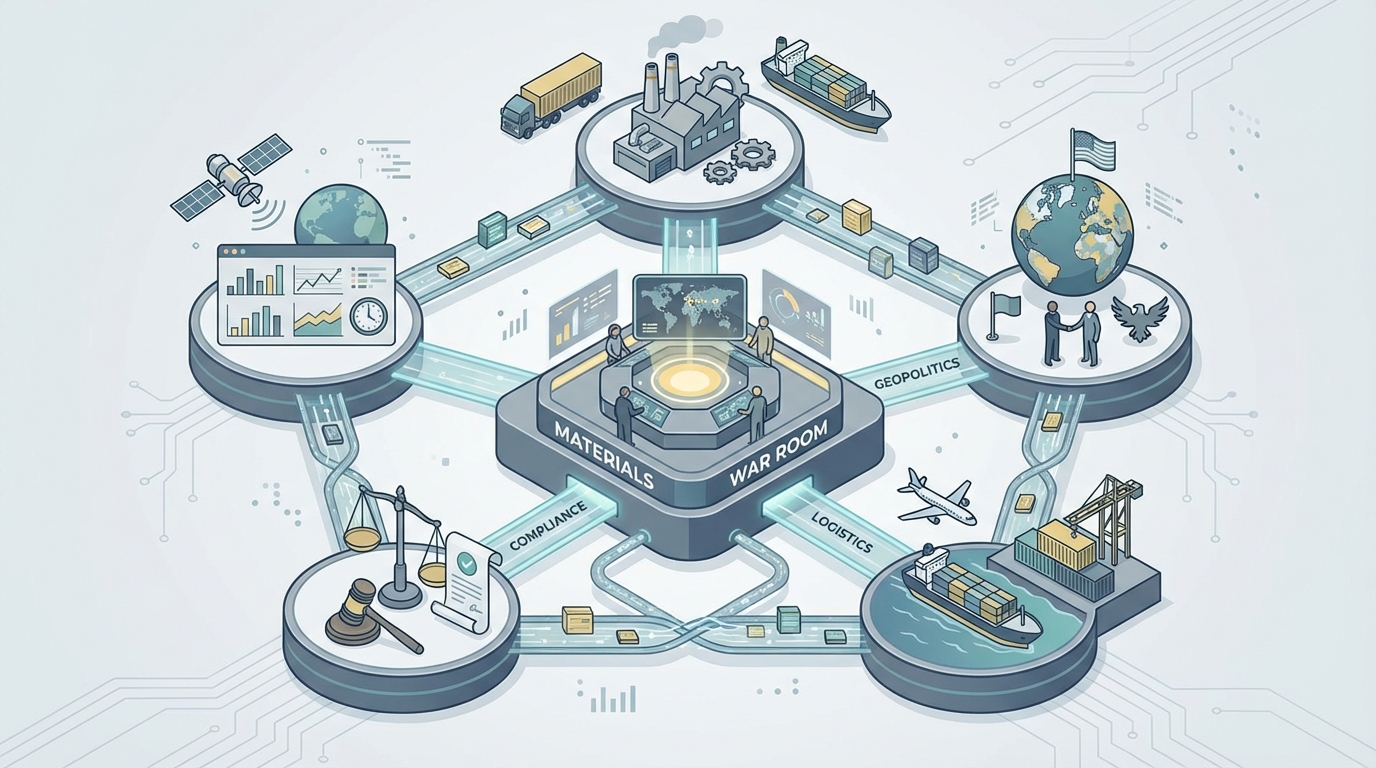
A Materials War Room is a cross-functional command center focused on real-time monitoring and coordinated response to disruptions in strategic metals and rare earth supply chains. In practice, it has looked less like a dramatic crisis bunker and more like a disciplined combination of people, data, and routines dedicated to understanding exposures around REEs, lithium, cobalt, nickel, tungsten, PGMs, and related logistics and regulatory constraints.
In several organizations, the trigger for creating such a war room has been a specific shock: tighter Chinese rare earth export controls, unforeseen outages at DRC cobalt operations, or Indonesian nickel policy shifts that cascaded into cathode plant slowdowns. Over time, these war rooms evolved into standing capabilities rather than ad‑hoc crisis responses.
Key Operational Tensions and Signals to Track
- Tradeoffs: Centralizing intelligence vs. preserving local sourcing autonomy; transparency across business units vs. sensitivity around supplier and geopolitical exposure.
- Risks & failure modes: War room treated as a dashboard-only project, no decision rights; over-reliance on a single geography (e.g., China for REEs, DRC for cobalt, Russia for PGMs); ESG data gaps around artisanal or high-risk sources.
- Indicators to watch: Export quotas and licensing changes (e.g., Chinese REEs, Indonesian nickel), sanctions and trade restrictions (e.g., Russian palladium, Iranian metals), and chokepoints in logistics (Panama Canal, Red Sea routes, Southern African rail corridors).
- Organizational signals: Recurring last-minute expediting, board questions about critical minerals, and fragmented internal spreadsheets are common precursors to formal war room setups.
- Technology tension: Rich alerting through AI and satellite feeds vs. alert fatigue and mistrust of opaque models.
1. Framing the Scope and Objectives of the Materials War Room
The starting point observed in effective war rooms has been a sober discussion of scope: which materials, which business units, and which tiers of the supply chain fall under its remit. Many teams have used recent USGS critical minerals lists or the EU Critical Raw Materials Act (CRMA) annexes as a neutral backbone, then overlaid internal dependency mapping: for example, neodymium and dysprosium for permanent magnets in defense systems, lithium carbonate equivalent (LCE) for battery lines, cobalt for aerospace alloys, palladium and platinum for autocatalysts and fuel cells.
Where scopes have remained vague (“monitor all commodity risk”), war rooms tended to drift into generic market commentary. Where scopes were defined in terms of concrete failure scenarios (“interruptions at these ten named assets or routes would stop these three product lines”), the resulting analysis and escalation paths became more actionable.
In several cases, executive sponsorship was unlocked not by abstract resilience language, but by anchoring the war room in existing obligations: Sarbanes‑Oxley style annual risk assessments, conflict minerals reporting, or defense procurement requirements around traceability and origin for REE magnets and tungsten components.
2. Team Composition and Governance: RACI in Practice
Operational war rooms for strategic metals have typically involved 8-12 core participants drawn from procurement, supply chain, engineering/R&D, legal and compliance, and IT/data. The configuration that recurs most often is a RACI-style structure:
- Responsible: Supply chain and category analysts who track mines, refineries, and key recyclers (for example, following MP Materials’ Mountain Pass for NdPr oxides, Lynas’ separation facilities, or Glencore’s Mutanda cobalt operations).
- Accountable: A senior operations or procurement executive empowered to trigger responses such as qualifying an alternative supplier, re‑sequencing production, or drawing on stockpiles.
- Consulted: Regulatory and ESG specialists familiar with CRMA, U.S. defense sourcing rules, conflict minerals guidance, and sanctions regimes affecting, for instance, Russian nickel and palladium producers.
- Informed: Finance, product leadership, and in some cases the board risk committee, via concise periodic updates.
One discovery many teams reported was the risk of role overlap: when multiple functions implicitly believed they were the ultimate decision-makers, reaction time during a disruption lengthened rather than shortened. Explicit decision trees – for instance, clarifying who can approve a temporary sourcing shift from a Chinese rare earths separator to an Australian or US alternative – helped reduce this confusion.
3. Designing the Physical and Digital War Room Environment
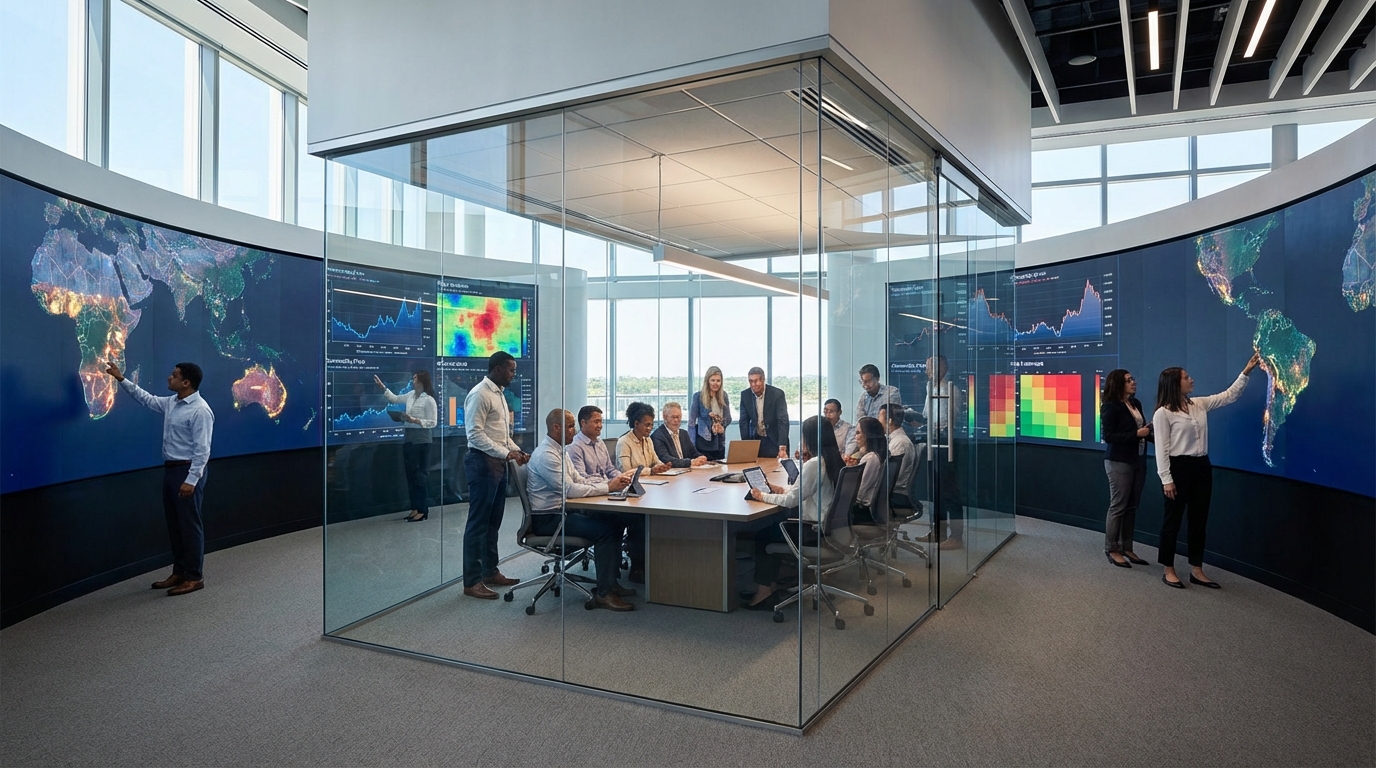
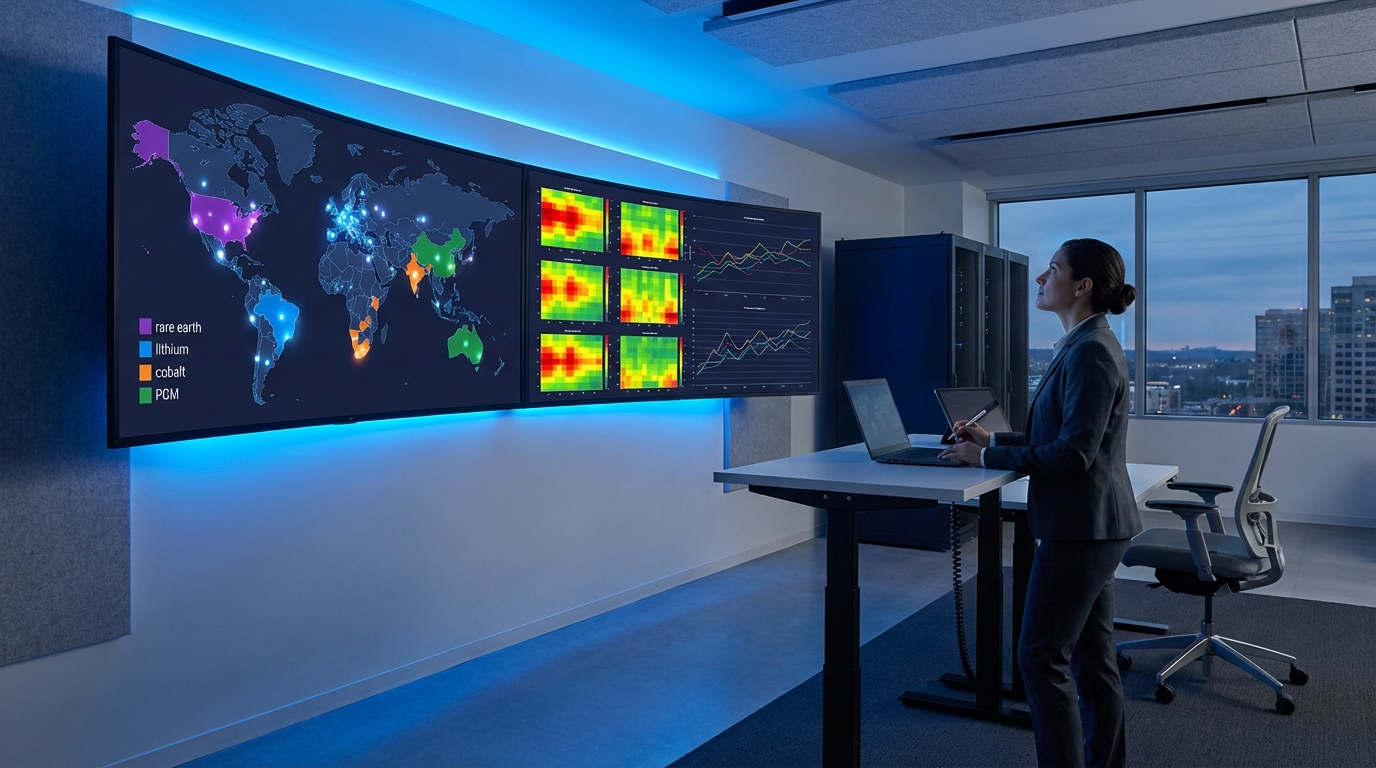
Material war rooms have taken two complementary forms: a dedicated physical space and a persistent digital environment. The physical space often features large displays with a “single pane of glass” view: maps of key assets and routes, current operational status, open incidents, and a ranked risk list. Typical maps would call out locations such as Mountain Pass (USA) for REEs, Greenbushes (Australia) for lithium, Mutanda and Kamoa-Kakula (DRC) for cobalt and copper, and Norilsk operations in Russia for nickel and palladium.
Digitally, teams have converged on a mix of business intelligence tools (e.g., Tableau, Power BI), enterprise risk platforms, and custom dashboards fed by:
- Authoritative geological and production data (e.g., USGS reports, company technical disclosures).
- Trade and logistics feeds, including vessel tracking for key concentrates and refined products.
- Regulatory and sanctions updates tied to critical jurisdictions (China, DRC, Indonesia, Russia, South Africa).
- News and specialist commentary on specific assets such as Lynas’ Kalgoorlie plant ramp-up or Albemarle’s Australian expansions.
A recurring pitfall has been overloading the environment with datasets without a clear “question hierarchy.” War rooms that worked well tended to start from a small canon of recurring questions – for example, “Which five assets, if disrupted, would halt more than a defined fraction of magnet or battery output?” – and only integrated data that helped answer those questions reliably.
4. Mapping Critical Assets, Routes, and Dependencies
An effective foundation has been a curated list of critical assets, processes, and routes. In the REE and strategic metals context, such a list often included:
- Upstream mines and concentrators (e.g., MP Materials for REO concentrates, Pilbara or Greenbushes for spodumene, Ivanhoe’s Kamoa‑Kakula for copper and associated cobalt).
- Midstream refineries and separation plants (e.g., Lynas’ facilities in Australia and Malaysia, Chinese magnet producers in Jiangxi and Inner Mongolia, nickel HPAL plants in Indonesia).
- Recycling hubs (e.g., European PGM and battery recyclers such as Umicore’s sites, North American catalyst recyclers).
- Transport corridors: DRC to Durban via rail and truck, Indonesian nickel flows to Chinese and Korean smelters, Russian PGMs through Baltic and Turkish ports, and North American road and rail routes to defense contractors.
In practice, these maps were most useful when linked to bill-of-materials data and product lines. For instance, some aerospace teams tagged specific engine or guidance systems that depended on tantalum or REE components traced to Central African and Chinese assets, which in turn shaped priority levels during scenario analysis.
5. Structuring Risk Identification Across Categories
To move beyond ad-hoc issue tracking, many war rooms adopted a categorization framework that echoed information-security standards (such as NIST SP 800‑53 or ISO-style risk catalogs) but applied to materials. Typical categories included:
- Supply concentration: High dependence on single-country sources (e.g., China for REE separation, DRC for cobalt, Russia for certain PGMs).
- Geopolitical and regulatory risk: Export quotas, sanctions, nationalization pressures, or resource nationalism (Indonesia’s evolution from ore bans to processing mandates, for example).
- ESG and social license: Artisanal mining risks in the Copperbelt, community conflicts near Latin American lithium brines, or power and water constraints in South African PGM belts.
- Technical and quality risk: Qualification bottlenecks when switching from Chinese-made NdFeB magnets to alternative suppliers, or from one lithium chemical form to another.
- Logistics and infrastructure: Port congestion, canal droughts, rail strikes, or chronic power instability affecting smelters and refineries.
During initial build-outs, teams often discovered that existing risk registers either treated these issues at an extremely high level (“country risk: high”) or buried them as scattered line items in procurement files. The war room process brought them into a single, continuously updated catalog tied to specific assets and routes.
6. Risk Scoring and Prioritization: Likelihood, Impact, Velocity
A common practice has been to translate qualitative discussions into consistent scoring using three axes:
- Likelihood: Based on recent history, political trajectories, climate patterns, and corporate disclosures.
- Impact: Measured not in prices, but in operational disruption: lost production days, delayed programs, or regulatory non‑compliance risks.
- Velocity: How quickly disruption would be felt once triggered – for example, just‑in‑time palladium flows from Russian refiners vs. long‑cycle tungsten stockpiles.
Some teams overlaid a fourth dimension: detectability. Satellite monitoring of mine tailings, vessel tracking, and near-real-time news analytics raised detectability on certain assets, which in turn made some high‑likelihood issues more manageable.
One illustrative internal exercise modeled a scenario where a tightening of Chinese rare earth export quotas triggered a 30% move in neodymium prices. The exact price path was less important than what it revealed: the need for clear thresholds at which escalation would be triggered, such as activating alternative suppliers in Australia or North America, drawing on strategic stockpiles, or accelerating recycling programs for magnets and catalysts.
7. Response Playbooks: Diversification, Substitution, Buffers
Once high‑priority risks were identified, war rooms that delivered tangible value tended to maintain explicit “playbooks” rather than relying on improvised responses. These playbooks covered, for example:
- Diversification: Examples included shifting part of REE separation volumes from Chinese tolling contracts to emerging Australian capacity, adding non‑DRC cobalt sources (e.g., from Canada or Australia) alongside Glencore and other Copperbelt producers, or qualifying additional PGM refiners outside of high‑risk jurisdictions.
- Substitution and thrifting: Engineering-led initiatives to reduce cobalt intensity in cathode chemistries, increase platinum-to-palladium substitution where feasible, or redesign components to accept a wider range of REE sourcing specifications.
- Stockpiles and inventory buffers: Strategic holdings of select PGMs or specialized REE alloys, sized to cover critical programs for a defined period. In some sectors, a six‑month palladium or dysprosium buffer for defense applications appeared as a reference point in planning discussions.
- Contractual and insurance levers: Diversification and force‑majeure clauses, political risk insurance for high‑exposure assets, and logistics insurance for vulnerable routes like the Panama Canal or the Red Sea.
One pattern that became evident was that playbooks needed to be tightly coupled to engineering and qualification timelines. For example, an automotive program that depended on a specific Chinese magnet vendor could not simply switch overnight to a new Lynas- or Japanese-made magnet without validating performance, durability, and regulatory certifications. War rooms that mapped those lead times explicitly were better positioned to choose between short‑term buffering and longer‑term redesign.
8. Monitoring Technology, Data Feeds, and AI
Data has been central to most materials war rooms, but deployment has varied dramatically. A common baseline included:
- Regular pulls from geological and mining agencies (USGS, national surveys) and company production reports.
- Specialist market intelligence on strategic metals and REEs.
- Regulatory trackers for sanctions, export controls, and environmental approvals.
- Logistics telemetry – AIS data for bulk carriers, port congestion indicators, and occasionally satellite imagery for mine or smelter activity.
AI-based systems have increasingly been layered on top, generating alerts when narratives around specific assets change (for example, increased reporting on labor unrest at a South African PGM mine or new draft export rules for Chinese gallium and germanium). However, teams frequently encountered alert fatigue and skepticism about opaque models.
To address this, some war rooms adopted tiered thresholds: low‑level alerts logged silently in the background, medium alerts surfaced in weekly scans, and high‑severity triggers – such as credible evidence of sanctions on a major PGM producer or closure of a key cobalt export route – pushed directly to the accountable executive with a clear time window for assessment.
9. Cadence, Simulations, and Learning Loops
Operational cadence has proved as important as tooling. A pattern that emerged from several organizations involved:
- Short daily or near‑daily huddles during active disruptions, focused tightly on status, new information, and immediate decisions.
- Weekly or bi‑weekly “scan” meetings, where the full risk landscape was reviewed, new risks logged, and scores adjusted.
- Quarterly simulations or “war games” around scenarios such as a sudden Indonesian nickel policy change, tightening Chinese rare earth quotas, an extended South African power crisis affecting PGM supply, or rail disruption out of the DRC.
Post‑incident reviews turned out to be particularly valuable. For example, one team discovered during a cobalt logistics disruption that critical knowledge about alternative trucking routes out of Katanga was held only by a single regional buyer. The war room process led to codifying that route intelligence and embedding it into the central playbook.
10. KPIs, Auditability, and Scaling the War Room
Over time, mature materials war rooms gravitated toward a small set of performance indicators used both to steer internal improvements and to satisfy board or regulator scrutiny. Common examples included:
- Time to detect: Average time between an external trigger (e.g., public announcement of a quota or ban) and its appearance in the war room dashboard.
- Time to decision: Duration from confirmed incident to a documented decision on response (diversification, substitution, stockpile drawdown, or other action).
- Diversification scores: Share of critical materials volume coming from any single country or supplier, sometimes tracked against internal thresholds (for example, maximum exposure levels to one jurisdiction for REE separation or cobalt refining).
- Compliance coverage: Proportion of critical suppliers with updated ESG, human rights, and sanctions screening records.
Auditors and compliance teams frequently engaged with war rooms as a single location where evidence of structured risk management could be examined: meeting minutes, risk logs, escalation records, and scenario analyses. In at least one case, such documentation proved decisive in demonstrating that board oversight of critical mineral risks was not merely nominal.
Scaling often involved either deepening the war room’s role within a particular material group (for example, a dedicated REE cell that followed MP Materials, Lynas, key Chinese separators, and emerging Vietnamese projects in detail) or extending its scope to adjacent materials like graphite, manganese, or high‑purity silicon where similar concentration risks were emerging.
Closing Observations
The Materials War Room concept has evolved from an emergency response mechanism into a standing analytical and coordination hub for strategic metals supply chains. Across regions and sectors, a few elements have proven especially consequential: a clearly bounded scope tied to concrete failure scenarios; explicit governance and decision rights; integrated but disciplined data environments; and response playbooks that recognize engineering and qualification realities.
As export controls, sanctions, climate impacts, and social license pressures continue to reshape the geography of mining, refining, and recycling, organizations that have institutionalized such war rooms appear better positioned to explain their exposure, document their decisions, and adapt their sourcing architectures across REEs, battery metals, and precious metals alike.


