
Uncategorized
China’s Gallium Licensing and U.S.-Targeted Ban: Price Spike, 2027 Tightness, and the Supply-Chain


Key Takeaways
- China accounts for ~98% of global low-purity gallium, creating a structural supply choke point.
- Export licensing (from Aug 2023) and a U.S.-targeted ban (announced Dec 3, 2024; suspended Nov 2025–Nov 2026) drove spot prices from about $240/kg to roughly $575/kg.
- Ongoing licensing discipline and technology controls are likely to keep supply risk elevated through at least 2027.
- Producers and downstream operators should map exposure, lock multi-year offtakes from non-Chinese sources, and build strategic stockpiles where feasible.
The Gallium Shock: Market Dynamics and Strategic Imperatives
Executive Summary
Materials Dispatch assesses how China’s near-monopoly on gallium—a byproduct metal vital for gallium-arsenide (GaAs) and gallium-nitride (GaN) semiconductors—has been leveraged through export licensing and a targeted restriction on U.S. shipments. Licensing controls since August 2023 and a Dec. 3, 2024 ban (suspended Nov. 2025–Nov. 2026) helped push spot prices from about $240/kg in mid-2023 to roughly $575/kg by December 2024. Crucially, the measures did not only constrain trade flows; they also tightened access to extraction technologies (notably ion-exchange/resin pathways). That combination supports structurally high supply risk through at least 2027, forcing semiconductor, defense, and power-electronics supply chains to move from scenario discussion to operational resilience planning.
Market Context and Supply Concentration
Gallium is recovered as a minor stream from aluminum and zinc refining, yet it underpins key technologies: RF front-ends, power electronics, radar, optical sensors, and high-efficiency LEDs. China controls approximately 98% of global low-purity output, creating a single-point failure dynamic for anything that depends on refined gallium supply. The strategic implication is straightforward: even when end-market demand is stable, licensing and technology controls can abruptly alter availability of material that downstream firms cannot easily substitute in the short run.
Before restrictions, U.S. exposure was especially sensitive because the supply chain was narrowly sourced and inventory depth was thin relative to the scale of semiconductor and defense demand. In practice, that means “spot” availability is not only a function of production capacity—it reflects whether qualified sellers can ship and whether customs clearance and end-use declarations remain acceptable under the licensing regime.
Policy Timeline and Price Impact
Licensing Shock (Aug 2023): Exports of gallium and germanium required MOFCOM licenses and end-use declarations (export licensing is a permit system where authorities review the exporter, end-user, and intended use). Chinese customs data indicated near-zero wrought gallium exports during the first months after controls tightened. Exports then reappeared at much lower volumes in October 2023—reflecting the compliance friction and discretionary nature of licensing. Spot markets responded quickly: prices moved higher by the October 2023 period, setting the tone for a prolonged repricing rather than a brief spike.
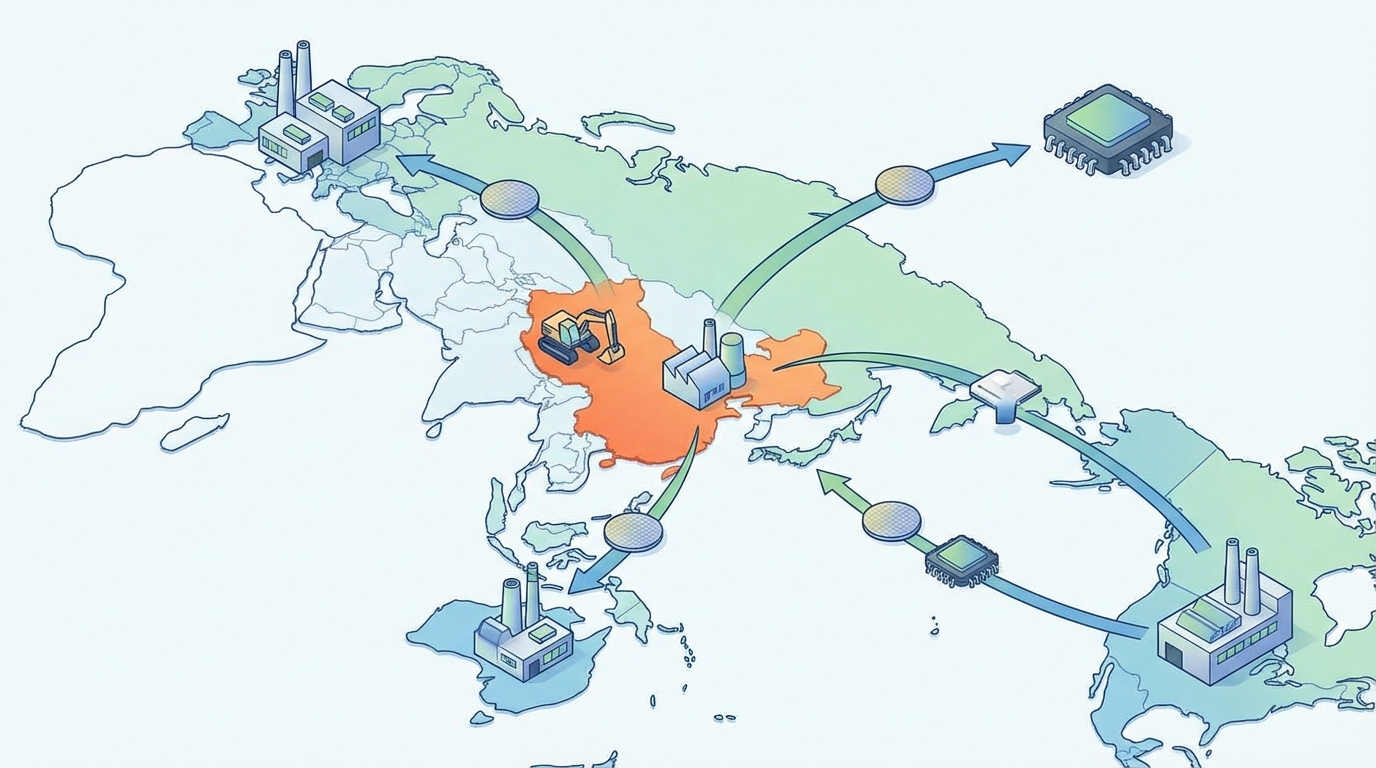
U.S. Ban & Technology Controls (Dec 3, 2024): MOFCOM escalated measures with a country-specific export ban on gallium, germanium, antimony, and superhard materials to the United States. At the same time, the export control catalogue was expanded to restrict gallium extraction technologies—specifically “technologies and processes to extract metallic gallium from alumina mother liquor using ion-exchange or resin methods.” That matters commercially because it targets the recovery pathway that supports conversion from feedstock streams into metal. Prices peaked at about $575/kg in December 2024 as buyers priced in both reduced trade access and reduced medium-term recovery optionality.
Partial Suspension (Nov 2025–Nov 2026): A temporary lift of the U.S. ban reduced political signalling risk but did not remove the underlying licensing and technology controls. As a result, downstream buyers should not interpret the suspension as a full return to “pre-shock” market normalcy; it primarily changes the risk of outright shipment prohibition to the U.S., while compliance requirements and technology restrictions continue to constrain the broader supply system.
Economic and Strategic Impacts
Gallium’s supply leverage becomes visible in how quickly disruptions propagate into manufacturing lead times. A gallium shortage is not like a commodity inventory issue that can be resolved through routine brokerage; it can interrupt component qualification cycles for GaAs/GaN RF and power devices, slow radar and sensor procurement timelines, and complicate substitution decisions across device architectures.
Regulatory attention also follows the supply logic. In Europe, gallium’s status as a strategic resource has been used to reinforce the policy focus on critical raw materials—an approach designed to support diversification, transparency, and stockholding where supply risk is concentrated. Taken together, these developments underline a market reality: the “real” constraint is not only mining or refining volumes, but the ability to legally and technically recover gallium into usable forms.
Supply-Side Response
Global high-purity production and recycling are meaningful balancing factors, but the shock exposed how asymmetric the geography of upstream capability remains. Non-Chinese recovery projects have been announced across multiple jurisdictions, yet most are still at feasibility, engineering, or early implementation stages relative to the immediacy of downstream demand. That lag is economically important: even credible projects do not neutralize risk for lead times that can span quarters of device fabrication and qualification.
Recycling capacity outside China remains limited compared with the scale implied by global tightness. For industrial planners, that means the “supply response” is likely to be incremental rather than immediate—pushing the market toward a longer period of negotiated offtakes, careful quality management, and higher dependence on storage and contracted procurement.
Scenarios & Probabilities
- Managed Constriction (Base Case, ~60%): Licensing remains discretionary and technology controls remain in place. Price premiums persist as buyers continue to source via contracted channels rather than pure spot purchasing, while non-Chinese capacity additions gradually improve medium-term availability toward the late 2020s.
- Escalation & Crackdown (High Stress, ~25%): Renewed geopolitical tensions increase the likelihood of targeted enforcement, re-export scrutiny, and sharper shipment restrictions. The outcome is less about total global output and more about sudden loss of route access—driving acute shortages and episodic spikes.
- Diversification Relief (Optimistic, ~15%): Alliances deepen and recovery pathways diversify. Alternative resin and processing compliance pathways, plus more robust upstream contracting, reduce reliance on Chinese-origin supply and gradually ease pricing pressure toward earlier baselines.
Actionable Intelligence
Materials Dispatch recommends a three-horizon response:
- Immediate (Next 4 Weeks): Map gallium exposure to Tier-3 suppliers (not just cell or device assemblers). Stress-test inventories against a six-month cutoff scenario, and review force-majeure plus re-export clauses to ensure contractual compliance aligns with export licensing requirements and end-use documentation expectations.
- Short-Term (Next Quarter): Secure multi-year offtake agreements with non-Chinese recovery/refining counterparties where quality and compliance can be validated. Align corporate stockpile targets with national or consortium initiatives (including programs referenced in U.S. and EU contexts, such as Project Vault and EU critical-material policy efforts), focusing on the material forms actually required by downstream processes.
- Long-Term (Through 2027+): Co-invest in upstream recovery and recycling pathways, and integrate gallium risk into fab siting and product qualification planning. Codify critical-material playbooks for single-supplier and route-access scenarios to prevent procurement decisions from being driven solely by spot price movements.
Signals to Monitor
- Price Levels: Track European and global spot markers closely, but treat large price prints as a sign of route-risk and licensing friction—not just supply scarcity.
- Policy Updates: Monitor MOFCOM notices for changes in licensing mechanics, expansions or clarifications of extraction-technology controls, and any further updates to U.S. ban suspension timing after Nov 2026.
- Re-export Flows: Watch for discrepancies between Chinese export reporting and U.S./EU import data, particularly when routing intermediates appear to increase.
- Project Milestones: Prioritize announcements tied to FID and commissioning timelines for non-Chinese recovery capacity, since earlier-stage plans do not address near-term procurement constraints.
- Stockpile Actions: Follow public procurement developments and strategic-reserve frameworks that attempt to translate policy intent into physical availability.
Conclusion
China’s export licensing and the U.S.-targeted ban have crystallized gallium’s role as a strategic lever in semiconductor and defense supply chains. With technology controls aimed at extraction pathways, tightness risk is likely to remain elevated through at least 2027 even when the U.S. shipment restriction is temporarily suspended. Operators should accelerate exposure mapping, diversify sourcing through credible non-Chinese projects, and institutionalise strategic stockpiling and contractual compliance to reduce vulnerability to future route disruptions.


